Intermediate habitat. Occurs in rocky areas and transitional zones,
including environments with empty snail shells.
Geographic distribution:
Distributed around Lake Tanganyika, except in the northernmost
sub-basin (Burundi and the corresponding Congolese coast), where it is
replaced by Telmatochromis brichardi or
Telmatochromis bifrenatus.
Typical adult size:
Up to about 10 cm total length. Females are slightly smaller.
A shell-dwelling variant grows significantly smaller, reaching
approximately 6 cm.
Sexual dimorphism:
Males grow larger than females, which remain slightly smaller and
more slender.
Recommended aquarium size:
100 L.
Aquarium setup:
Aquarium with numerous rocks forming caves. Fine sand substrate,
supplemented with empty snail shells.
Diet:
Omnivorous. Feeds primarily on algae and other microorganisms living
in the aufwuchs, which are removed with a characteristic jerking
movement of the body forming an “S” shape.
Breeding:
Substrate spawner. Spawning occurs in caves or empty snail shells.
The female deposits around 50 eggs, which are fertilized by the male.
Both parents participate in brood care.
Aggression:
Can be aggressive toward conspecifics, but otherwise a relatively
peaceful cichlid suitable for community aquaria, provided tank mates
are not overly large or aggressive.
Special notes:
Two ecological variants of Telmatochromis vittatus are known.
The larger form inhabits rocky environments, while the smaller form
lives in shell beds and is commonly referred to as
Telmatochromis vittatus shell. T. vittatus is very similar to T. brichardi and the two
species are often difficult to distinguish. The larger rocky form of
T. vittatus can usually be separated by its greater adult size,
whereas the shell-dwelling forms are extremely similar in size,
appearance, and behavior, making reliable identification difficult.
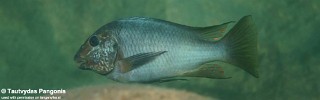
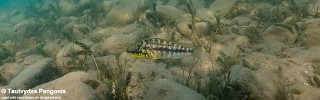
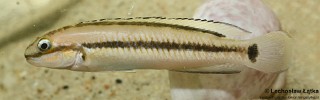
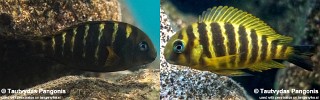
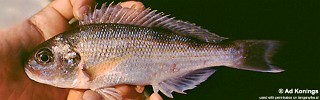



A shell-dwelling variant grows significantly smaller, reaching approximately 6 cm.
Both parents participate in brood care.
T. vittatus is very similar to T. brichardi and the two species are often difficult to distinguish. The larger rocky form of T. vittatus can usually be separated by its greater adult size, whereas the shell-dwelling forms are extremely similar in size, appearance, and behavior, making reliable identification difficult.
Photo gallery