Western shore of Namansi village, Lake Tanganyika, Tanzania
(Rukwa Region, Nkansi District; depth 5–10 m)
Biotope:
Rocky habitats with large boulders, occupying dark crevices and caves.
Typically found in shaded, low-light areas, often swimming inverted beneath
overhangs; rarely observed in open spaces.
Geographic distribution:
Restricted to a limited section of the southeastern Tanzanian coast of Lake Tanganyika,
from Mvuna Island south to Kalala Island, including associated islands and reefs
in the Kipili area.
Typical adult size:
Males up to ~16 cm TL; females up to ~14 cm TL
Sexual dimorphism:
No clear differences in coloration or morphology; males are on average
10–15% larger than females.
Recommended aquarium size:
150 L for a single bonded pair
Aquarium setup:
Dimly lit aquarium with extensive rockwork forming deep caves and narrow crevices.
Best maintained as a single pair; avoid keeping together with other
Chalinochromis species to prevent aggression and hybridization.
Diet:
Likely feeds on soft-bodied invertebrates and insects.
In aquarium, accepts frozen and high-quality prepared foods for carnivorous cichlids.
Breeding:
Substrate spawner breeding deep inside dark caves.
Both parents guard eggs and fry; brood sizes of around 70 juveniles
documented in aquarium conditions.
Aggression:
Aggressive towards conspecifics and closely related species,
especially within the genus Chalinochromis.
Special notes:
Described only in 2014 and still rare in aquaristics.
A highly localized species with a very restricted distribution,
making it potentially vulnerable despite no known direct threats.
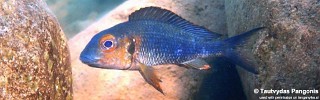
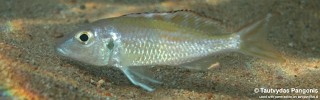
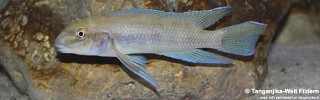
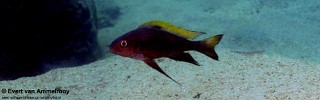
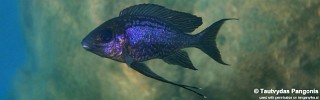



Photo gallery