Inhabits the intermediate habitat of Lake Tanganyika, where sandy areas meet rocks.
The species is most commonly encountered at depths of about 3–5 m.
Geographic distribution:
Occurs along the eastern shore from the Kigoma area northwards, including Nyanza-Lac.
Around Kigoma it occurs sympatrically with Ophthalmotilapia nasuta, and at Kigoma it shares habitat with
Ophthalmotilapia sp. ‘Whitecap’.
Typical adult size:
Males reach around 15 cm total length, with females remaining about 2–3 cm smaller
(commonly around 12 cm).
Sexual dimorphism:
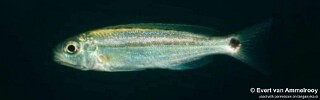
Only males develop strong coloration; females remain greyish and less conspicuous.
Males are larger, darker and bluer than females and have longer fins, especially the pelvic fins.
During the breeding period, the yellow tips of the pelvic fins inflate in a ‘bat-like’ fashion.
Recommended aquarium size:
400 L, or at least 150 cm tank length.
Aquarium setup:
Ophthalmotilapia sp. ‘Paranasuta’ is sensitive to transport and acclimation, but becomes
relatively hardy once established under suitable conditions.
It should not be housed with aggressive cichlids; tank mates should be smaller and less aggressive species so
that males can become dominant and display their best coloration.
In terms of aggression it is described as similar to O. nasuta and less aggressive than species such as
O. ventralis.
Provide fine sand, as males construct volcano-shaped sand nests. Unlike O. nasuta and other members of
the genus that often place nests on top of large rocks, this species is reported to build nests between rocks or
stones.
In addition to a large open sandy area, include some rocks for structure.
It is best kept in groups with more females than males.
Diet:
Omnivorous, feeding mainly on aufwuchs composed of filamentous algae, diatoms and associated
microorganisms.
It is also reported that non-territorial fish may take plankton, and in aquarium the species is noted to do well
on a primarily vegetable-based diet.
Breeding:
Maternal mouthbrooder, breeding in a manner comparable to other Ophthalmotilapia.
Males establish leks and construct large sand bowers in the intermediate habitat, then display to approaching
females and lead them toward the spawning site with quivering swimming.
The female is attracted by the yellow lappets at the ends of the pelvic fins rather than anal-fin ocelli.
The female may be left alone in the nest while the male chases intruders, and she may sometimes lay eggs alone
before the male returns and quivers against the substrate.
After spawning the female leaves the male’s area and mouthbroods alone; after spawning, removal of the female is
sometimes recommended due to male aggression.
Aggression:
Described as less aggressive than other Ophthalmotilapia species, with aggression similar to
O. nasuta.
Territorial males still defend nesting sites and may become aggressive during breeding and while guarding the
area.
Special notes:
This taxon was described by P. Tawil in 2014 and had previously been repeatedly misidentified in the
hobby and literature, most often as O. heterodonta, and also as O. ventralis or
O. ventralis heterodonta.
Males are distinguished from other members of Ophthalmotilapia by a head profile with a slightly
protruding, nose-shaped snout in adulthood, resembling a reduced version of the much more pronounced “nose” of
O. nasuta.
Males are further characterized by a grey to dark blue body coloration with distinctly metallic dark blue
unpaired fins, especially on the distal portion of the caudal fin; females are described as indistinguishable
from those of O. ventralis and O. heterodonta.
Both sexes are reported to show vertical stripes, a feature not reported for other members of the genus, and this
has been cited as contributing to an “intermediate” appearance between the O. ventralis and
O. nasuta groups.
The species is considered a geographic replacement form relative to O. nasuta, and it has been
emphasized that O. nasuta and O. sp. ‘Paranasuta’ have not been found together in the natural
habitat. A reported distinguishing point is that females of O. nasuta may show dark vertical flank bars,
while females of O. sp. ‘Paranasuta’ are reported to lack these bars.





The species is most commonly encountered at depths of about 3–5 m.
Around Kigoma it occurs sympatrically with Ophthalmotilapia nasuta, and at Kigoma it shares habitat with Ophthalmotilapia sp. ‘Whitecap’.
Males are larger, darker and bluer than females and have longer fins, especially the pelvic fins.
During the breeding period, the yellow tips of the pelvic fins inflate in a ‘bat-like’ fashion.
It should not be housed with aggressive cichlids; tank mates should be smaller and less aggressive species so that males can become dominant and display their best coloration.
In terms of aggression it is described as similar to O. nasuta and less aggressive than species such as O. ventralis.
Provide fine sand, as males construct volcano-shaped sand nests. Unlike O. nasuta and other members of the genus that often place nests on top of large rocks, this species is reported to build nests between rocks or stones.
In addition to a large open sandy area, include some rocks for structure.
It is best kept in groups with more females than males.
It is also reported that non-territorial fish may take plankton, and in aquarium the species is noted to do well on a primarily vegetable-based diet.
Males establish leks and construct large sand bowers in the intermediate habitat, then display to approaching females and lead them toward the spawning site with quivering swimming.
The female is attracted by the yellow lappets at the ends of the pelvic fins rather than anal-fin ocelli. The female may be left alone in the nest while the male chases intruders, and she may sometimes lay eggs alone before the male returns and quivers against the substrate.
After spawning the female leaves the male’s area and mouthbroods alone; after spawning, removal of the female is sometimes recommended due to male aggression.
Territorial males still defend nesting sites and may become aggressive during breeding and while guarding the area.
Males are distinguished from other members of Ophthalmotilapia by a head profile with a slightly protruding, nose-shaped snout in adulthood, resembling a reduced version of the much more pronounced “nose” of O. nasuta.
Males are further characterized by a grey to dark blue body coloration with distinctly metallic dark blue unpaired fins, especially on the distal portion of the caudal fin; females are described as indistinguishable from those of O. ventralis and O. heterodonta.
Both sexes are reported to show vertical stripes, a feature not reported for other members of the genus, and this has been cited as contributing to an “intermediate” appearance between the O. ventralis and O. nasuta groups.
The species is considered a geographic replacement form relative to O. nasuta, and it has been emphasized that O. nasuta and O. sp. ‘Paranasuta’ have not been found together in the natural habitat. A reported distinguishing point is that females of O. nasuta may show dark vertical flank bars, while females of O. sp. ‘Paranasuta’ are reported to lack these bars.
Photo gallery