Sandy habitats. Occurs at depths between 3 and 25 m.
Geographic distribution:
Northern and central part of Lake Tanganyika, where it replaces
Ectodus descampsii (Verne, 2001).
Typical adult size:
Up to about 14 cm (males), females usually around 12 cm.
Recommended aquarium size:
Minimum 150 L.
Aquarium setup:
Fine sand substrate is essential. Rocks are not required.
Diet:
Omnivorous. Feeds mainly on various invertebrates filtered from the sand.
Breeding:
Maternal mouthbrooder. A polygamous lek-forming species; males construct
saucer-shaped spawning sites in the sand and attract females for spawning.
Aggression:
Relatively peaceful. Multiple males can be kept together.
Special notes:
Ectodus sp. 'north' differs from Ectodus descampsii by a blue
dorsal fin (instead of yellow), a shorter snout and lachrymal bone, a larger
eye and a shallower body (Verne, 2001).
Sexual dimorphism is weak: mature males are slightly more colorful and show
a broader dorsal blotch surrounded by more blue.
According to Verne (2001), the description of this species was in progress but
is currently dormant. Northern populations are easy to distinguish from
E. descampsii by body shape and coloration, although potential overlap
or interbreeding zones remain unclear.

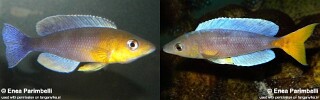






Sexual dimorphism is weak: mature males are slightly more colorful and show a broader dorsal blotch surrounded by more blue.
According to Verne (2001), the description of this species was in progress but is currently dormant. Northern populations are easy to distinguish from E. descampsii by body shape and coloration, although potential overlap or interbreeding zones remain unclear.
Photo gallery