Tanzania, Rukwa Province: Nkansi: Lake Tanganyika, Kamamba Island. 7 23' 51'' S, 30 33' 16'' E.
Biotope:
Transitional habitat between rocks and sand.
Observed at about 15 m depth around Kamamba and Kerenge Islands.
The habitat consists of sparsely scattered stones (0.2–2 m) on a white sand bottom.
Individuals are often seen swimming about half a meter above the bottom.
Adults (15–20 cm TL) are mostly solitary, while smaller individuals (up to about 10 cm)
are seen in pairs or small groups, usually up to four fish.
Geographic distribution:
Known only from the type locality around Kamamba Island,
slightly off the southern Tanzanian coast of Lake Tanganyika.
Also observed at the neighboring Kerenge Island, about 350 m to the north.
Typical adult size:
Up to about 15–20 cm total length.
The holotype (largest specimen in the type series) measures 137.2 mm SL,
thus around 15 cm TL.
Sexual dimorphism:
Not documented (all examined specimens were males).
No external sexual differences are described, but males are expected to become larger.
Recommended aquarium size:
500 L (recommended length around 200 cm).
Aquarium setup:
Provide sand and many rocks to create numerous passages and caves.
Keep the aquarium tightly covered and close all openings,
as the fish can jump out even at a relatively small size.
Keep either a pair or a single specimen.
If buying juveniles, it is recommended to start with around six individuals
and remove the others once a pair forms.
Suitable tank mates (in a sufficiently large aquarium) are other carnivorous
Tanganyika cichlids that are large enough not to be taken as prey
(e.g., Altolamprologus, Chalinochromis).
Avoid keeping with other Lepidiolamprologus to prevent unwanted hybridization.
Diet:
Carnivorous, specifically a piscivorous predator.
Like other large Lepidiolamprologus, it feeds mainly on smaller cichlids.
In aquarium, provide a high-protein diet and offer meaty frozen foods
such as fish, krill, and similar.
Breeding:
Breeding has not been observed in the natural habitat.
It is described as a pair-forming substrate spawner.
Because it is a large cichlid, it is expected to deposit eggs in the open
and defend them against other species.
Aggression:
Very aggressive, especially toward conspecifics.
If more than a single pair is kept, serious fighting and fatalities are likely.
Special notes:
Very similar to Lepidiolamprologus kendalli and differs only by extremely small
morphological differences; the most obvious difference is a lighter body pattern.
This lighter coloration appears to be an adaptation to the sandy habitat,
helping the fish blend with the substrate.
The species was discovered around Kamamba Island by Magnus and Mikael Karlsson
and described by Kullander in 2012.
Despite the close similarity to L. kendalli, it is treated as a valid species
because small diagnostic differences are present; however, it has also been suggested
it should be treated as a subspecies of L. kendalli.
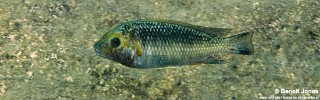
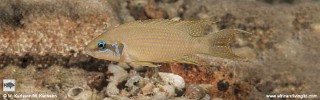
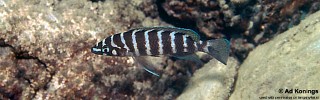



Photo gallery