Rocky habitats rich in sediment, typically in marginal areas rather than exposed, wave-washed rock zones.
Commonly associated with river mouths, deltas, swamps, lagoons, and shallow littoral zones, usually at depths below 5 m.
Geographic distribution:
Endemic to the Lake Tanganyika basin. Occurs widely in tributaries, river mouths, and nearshore habitats,
with records from areas such as Bujumbura, Kalambo, Katonga, the Ruzizi River system, Mpulungu, and Nyanza-Lac.
Typical adult size:
Males typically up to about 12 cm total length; females smaller, usually around 7–10 cm.
Sexual dimorphism:
Males grow significantly larger than females.
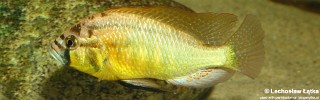
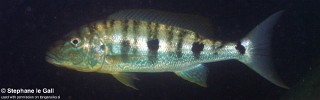
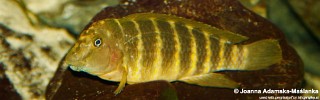
Aside from size, external differences are subtle, though males may show stronger coloration depending on social status.
Recommended aquarium size:
400 L
Aquarium setup:
Use a fine sand substrate and plenty of rocks to create caves, territorial boundaries, and breaks in line of sight.
Open areas with sand are important for territorial males to excavate shallow spawning depressions.
Robust plants or root structures may be added to provide cover for females and subordinate males.
Diet:
Omnivorous. Feeds largely on insects and other small invertebrates, but also consumes plant material and algae.
In aquaria, it readily accepts a wide range of quality dry, frozen, and live foods.
Breeding:
Mouthbrooder. The male establishes a territory and excavates a shallow pit in the substrate to attract females.
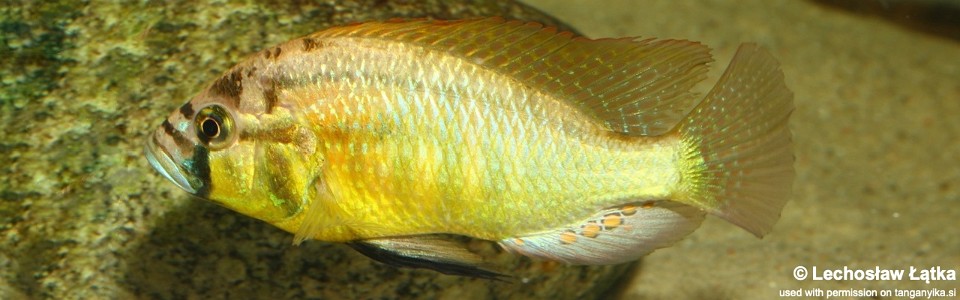
Eggs are picked up immediately by the female and fertilized inside the mouth as she attempts to collect the male’s anal ocelli.
The female incubates the brood for roughly 12–20 days; fry may seek refuge in the mother’s mouth for a short period after release.
Aggression:
Highly aggressive within the species, especially among males.
Keep either a single male with several females, or a larger mixed group to disperse aggression.
Territorial males may also confront other larger Tanganyikan cichlids.
Special notes:
A well-known haplochromine widely used as a model species in behavioural and neurobiological research.
Males occur in two main colour morphs (blue and yellow) and can switch between them depending on social status.
This species played a key role in the development of the classic “egg dummy” theory, as females mistake the male’s anal ocelli for eggs during spawning.




Open areas with sand are important for territorial males to excavate shallow spawning depressions. Robust plants or root structures may be added to provide cover for females and subordinate males.
Eggs are picked up immediately by the female and fertilized inside the mouth as she attempts to collect the male’s anal ocelli. The female incubates the brood for roughly 12–20 days; fry may seek refuge in the mother’s mouth for a short period after release.
Males occur in two main colour morphs (blue and yellow) and can switch between them depending on social status. This species played a key role in the development of the classic “egg dummy” theory, as females mistake the male’s anal ocelli for eggs during spawning.
Photo gallery