Luhanga, Lake Tanganyika, Democratic Republic of Congo
Biotope:
Rocky habitat at depths of about 10–60 m; observed at night on rocky substrate at
25–55 m and reported from gillnet catches at 10–60 m.
Observations at the type locality describe a small conglomerate cave/burrow at about
30 m depth, with fine sand and detritus on the bottom and occasional larger rounded
stones; the rear part of the cave narrows and bends behind a ledge.
Geographic distribution:
Endemic to Lake Tanganyika, and apparently restricted to the northern part of the lake.
Previously thought to be known only from Luhanga and Pemba (Democratic Republic of
Congo), but it has also been found around Kigoma (Tanzania).
Appears to be a rare species with a limited ability of dispersion.
Typical adult size:
Largest collected male: 66 mm standard length (87 mm total length). Largest female:
60 mm standard length.
Sexual dimorphism:
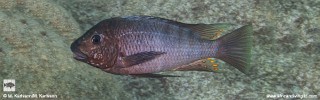
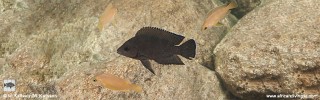
Males: up to ten dark brown vertical stripes or irregular spots on a brownish body, a
black band just above the base of the dorsal fin, and a black margin on the anal,
ventral and dorsal fin.
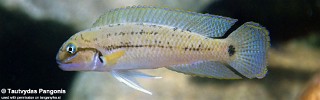
Females: a broad dark horizontal band from the base of the pectoral fin to about above
the vent, with some vertical stripes or spots above, followed by small dark vertical
bands; a black line in the center of the anal fin extending to the elongated rays, and
two short parallel black lines in the middle of the ventral fins.
Recommended aquarium size:
100–120 cm aquarium length.
Aquarium setup:
Fine sand substrate with some smooth, water-rolled rocks added as hiding places.
Very good water quality with efficient filtration and weekly water changes.
Diet:
Carnivorous; stomach contents have included shrimps. Sand and phytoplankton have also
been recorded and may have been ingested accidentally together with the shrimps.
Breeding:
Maternal mouth-brooder. Forty-one eggs with a diameter of about 1.5 mm have been
recorded from a ripe female.
Mouth-brooding females have been observed, but the broader breeding behavior is
otherwise unknown.
Aggression:
Very timid and non-aggressive; recommended to be kept alone in a species tank or, in a
community setup, only with equally peaceful companions.
Special notes:
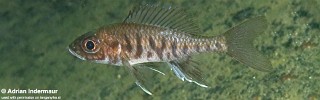
Distinct external diagnostic characters include a head profile with a slight notch behind
the eye and a rounded snout, a short anal-fin base with 7–8 soft rays (with the second
and third soft ray much elongated), and a flank pattern of black lines and blotches.
Field observations at the type locality reported up to about ten individuals of
different sizes inside a single cave/burrow, with females apparently in the majority;
at least one individual was mouth-brooding. Individuals were recognized by their
markings, which can differ on the two sides of the body.
The species has been observed during the day at the type locality in the same depth
range where it was previously caught at night; earlier gillnet catches were made with
nets left overnight on site.
The information presented here is based primarily on the original species description
by De Vos, Nshombo & Thys van den Audenaerde (1996), as well as on
detailed field observations and habitat data published by Heinz H. Büscher
in Tanganyika Magazyn no. 33.



Observations at the type locality describe a small conglomerate cave/burrow at about 30 m depth, with fine sand and detritus on the bottom and occasional larger rounded stones; the rear part of the cave narrows and bends behind a ledge.
Appears to be a rare species with a limited ability of dispersion.
Females: a broad dark horizontal band from the base of the pectoral fin to about above the vent, with some vertical stripes or spots above, followed by small dark vertical bands; a black line in the center of the anal fin extending to the elongated rays, and two short parallel black lines in the middle of the ventral fins.
Very good water quality with efficient filtration and weekly water changes.
Mouth-brooding females have been observed, but the broader breeding behavior is otherwise unknown.
Field observations at the type locality reported up to about ten individuals of different sizes inside a single cave/burrow, with females apparently in the majority; at least one individual was mouth-brooding. Individuals were recognized by their markings, which can differ on the two sides of the body.
The species has been observed during the day at the type locality in the same depth range where it was previously caught at night; earlier gillnet catches were made with nets left overnight on site.
The information presented here is based primarily on the original species description by De Vos, Nshombo & Thys van den Audenaerde (1996), as well as on detailed field observations and habitat data published by Heinz H. Büscher in Tanganyika Magazyn no. 33.
Photo gallery