Sheltered rocky habitats, especially dark zones beneath overhangs and
along vertical rock faces. Individuals typically move head-down or
upside down, keeping the belly close to the rock surface. The species
is common in shallow rocky areas.
Geographic distribution:
Rocky shores throughout Lake Tanganyika. Despite its lake-wide
distribution, only minor geographic variation is observed.
Typical adult size:
Commonly around 17 cm total length; females usually remain slightly
smaller at about 15 cm. In aquarium conditions, individuals have been
reported to reach up to 25 cm total length.
Sexual dimorphism:
Males are slightly larger than females; otherwise no clear external
differences are apparent.
Recommended aquarium size:
At least 400 L, with 600 L or more recommended.
Aquarium setup:
The aquarium should be arranged to form vertical rock faces, overhangs
and deep caves, allowing the fish to display its characteristic
head-down swimming behavior. This can be achieved with large stones
or structured 3D modules. Despite its unusual posture, the species
readily comes to the surface for food.
Each individual strongly defends its own territory, therefore a
large aquarium is essential. In sufficiently spacious tanks, several
individuals may be kept together, preferably in a harem structure
with one male and multiple females. Suitable tankmates are species
occupying other zones of the aquarium, such as robust sand-dwellers.
Diet:
Carnivorous predator. Feeds mainly on small crustaceans extracted from
holes and crevices in rocks, and occasionally on the eggs of
Lamprichthys tanganicanus. The digestive tract is about 50%
of total body length, and the sharp dentition reflects a predatory
feeding strategy.
Breeding:
A haremic species in nature, with a single male controlling a territory
containing up to ten or more females. Both sexes maintain individual
feeding territories; spawning occurs on the female’s territory,
typically beneath a rock overhang at depths of about 2–9 m.
Clutch size usually ranges from 50 to 100 greenish eggs. After
fertilization, the male leaves immediately, while the female alone
guards eggs and fry. Mortality is high, and typically only a small
number of fry reach the free-swimming stage.
Aggression:
Aggression is mainly expressed during territorial defense. Outside of
this context the species is relatively peaceful and generally does
not cause physical damage when expelling intruders.
Special notes:
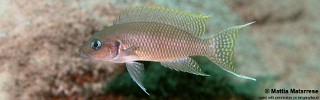
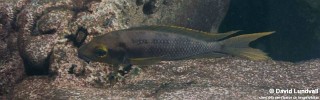
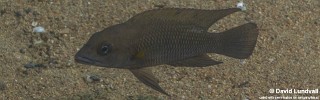
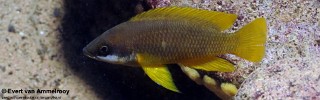
Distinguished by a triangular head, extremely large eyes, and a unique
head-down or inverted swimming posture. This behavior relies on very
precise swim-bladder control, which is highly sensitive to sudden
pressure changes.
Wild-caught specimens frequently exhibit swim-bladder dysfunction
after import or relocation, often resting motionless on the bottom
for extended periods before recovery. Similar problems may reappear
after handling or transfer between aquaria.
Comparison with Neolamprologus timidus:
Although often confused with N. timidus, the two species
differ in several consistent morphological traits. Caudal-fin shape
is highly variable in N. furcifer and overlaps with that of
N. timidus, and is therefore not a reliable diagnostic
character. More reliable differences include cheek squamation
(cheek scaled in N. timidus vs. naked in N. furcifer),
pelvic-fin structure (first soft ray longer than the second in
N. timidus, whereas the second soft ray is longer than the
first in N. furcifer), and proportionally longer head and
pectoral fins in N. timidus.
Melanin pattern also differs: adult N. timidus lacks a dark
spot at the caudal-fin base and may show thin, distinct horizontal
stripes on the trunk, while N. furcifer typically shows
thicker and less distinct markings.
Molecular phylogenetic analyses based on both nuclear and
mitochondrial DNA place N. furcifer and N. timidus
in separate clades within Lamprologini, each associated with
different related species, supporting their clear separation as
distinct species.




Each individual strongly defends its own territory, therefore a large aquarium is essential. In sufficiently spacious tanks, several individuals may be kept together, preferably in a harem structure with one male and multiple females. Suitable tankmates are species occupying other zones of the aquarium, such as robust sand-dwellers.
Clutch size usually ranges from 50 to 100 greenish eggs. After fertilization, the male leaves immediately, while the female alone guards eggs and fry. Mortality is high, and typically only a small number of fry reach the free-swimming stage.
Wild-caught specimens frequently exhibit swim-bladder dysfunction after import or relocation, often resting motionless on the bottom for extended periods before recovery. Similar problems may reappear after handling or transfer between aquaria.
Comparison with Neolamprologus timidus: Although often confused with N. timidus, the two species differ in several consistent morphological traits. Caudal-fin shape is highly variable in N. furcifer and overlaps with that of N. timidus, and is therefore not a reliable diagnostic character. More reliable differences include cheek squamation (cheek scaled in N. timidus vs. naked in N. furcifer), pelvic-fin structure (first soft ray longer than the second in N. timidus, whereas the second soft ray is longer than the first in N. furcifer), and proportionally longer head and pectoral fins in N. timidus.
Melanin pattern also differs: adult N. timidus lacks a dark spot at the caudal-fin base and may show thin, distinct horizontal stripes on the trunk, while N. furcifer typically shows thicker and less distinct markings.
Molecular phylogenetic analyses based on both nuclear and mitochondrial DNA place N. furcifer and N. timidus in separate clades within Lamprologini, each associated with different related species, supporting their clear separation as distinct species.
Photo gallery