Upper part of the water column in shallow water, typically within the top 10 meters.
Most often encountered over intermediate habitats with mainly sandy bottom and scattered stones,
though it also occurs in rocky environments. At night it appears to migrate to deeper levels and
rest on sandy bottom at depths of about 20 m and more.
Geographic distribution:
Endemic to Lake Tanganyika and recorded from many sites around the lake, indicating a
lake-wide distribution.
Typical adult size:
Up to about 8 cm total length in males; females are only a few millimeters shorter.
Sexual dimorphism:
No visible sexual dimorphism; females share the same coloration and are less than 5%
smaller than males.
Recommended aquarium size:
At least 200 L.
Aquarium setup:
Provide fine sand with a few scattered stones and ample open swimming space. Keep in a
group, as the species naturally forms very large schools. The species is small and delicate, so tank
mates should be chosen among peaceful, small Tanganyikan cichlids that will not outcompete it.
Diet:
Carnivorous zooplanktivore. Feeds on zooplankton, selecting individual organisms with a
protrusible mouth. Stomach content analyses have included micro-organisms, diatoms, bacteria, insect
larva remains, and small crustaceans.
Breeding:
Biparental mouthbrooder with very small eggs (about 2.0 mm). Brood size is low, commonly
in the range of about 6–15. The female initially broods the eggs; when fry reach about 5 mm (after
roughly 7 days), she transfers about half of the brood to the male. Both parents continue feeding
while brooding, and incubation lasts about three weeks; by the end, each parent typically carries
only a few fry (on average about two) of roughly 15 mm. In aquarium observations, the brooding
sequence may differ, with the female initially taking all eggs and later transferring them to the
male.
Aggression:
Peaceful toward conspecifics and other species.
Special notes:
Distinguished from Microdontochromis rotundiventralis by having a single row of teeth in
both jaws, a pointed distal margin of the pelvic fin, a proportionally longer innermost pelvic-fin
soft ray, a shallower body, and usually 10 anal-fin soft rays (versus usually 9). Adults usually
show vertical flank bars, whereas M. rotundiventralis lacks bars. This species was historically
placed in Xenotilapia, but later DNA-based work supported its placement in Microdontochromis; it also
differs from Xenotilapia in spending substantial time feeding in open water rather than only near the
bottom.
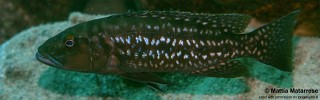
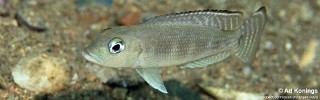
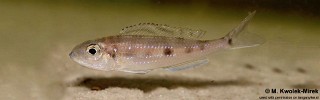
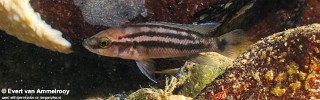
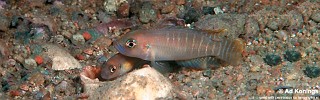



Photo gallery