Kinyamkolo (Mpulungu) and Mbity Rock, Lake Tanganyika, Zambia.
Biotope:
Inhabits the upper part of the rocky habitat and is most abundant at depths of about 3–5 m.
Geographic distribution:
Ophthalmotilapia ventralis occurs in the southern part of Lake Tanganyika.
It is found along the entire Zambian shoreline and also along the southern Congolese and southern Tanzanian
coasts.
From the Kalambo River northwards to the Kasanga area in southern Tanzania, populations are described as being
very similar to those found in Zambia.
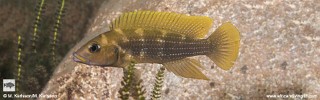
North of Kasanga and extending to Kitango Rocks in Kala Bay, a yellow form of O. ventralis is found.
African Diving considers this yellow form a potential distinct species and refers to it as
Ophthalmotilapia sp. ‘Ventralis Yellow Tanzania’. On this tanganyika.si this form is currently treated
as O. cf. ventralis.
On the western (Congolese) side of the lake, similar yellow populations are reported from Kapampa and Masanza and
are likewise treated here as O. cf. ventralis.
North of the range of the yellow form on both shores, another ventralis-like species occurs; this taxon is
regarded as distinct from O. ventralis and is treated as Ophthalmotilapia sp. ‘whitecap’.
Typical adult size:
Males reach around 15 cm total length, with females remaining about 2–3 cm smaller
(commonly around 12 cm).
Sexual dimorphism:
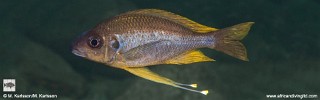
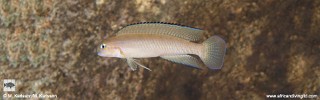
Only males develop strong coloration; females remain greyish and less conspicuous.
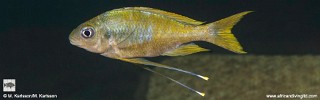
Males have longer fins than females, especially the pelvic fins.
Recommended aquarium size:
400 L when keeping multiple males.
In simpler setups with fewer males, a slightly smaller aquarium of around 300 L may be sufficient.
Aquarium setup:
Ophthalmotilapia ventralis is sensitive to transport and acclimation, but becomes relatively
hardy once established under suitable conditions.
It should not be housed with aggressive cichlids; tank mates should be smaller and less aggressive species so
that males can become dominant and display their best coloration.
Because of the likelihood of hybridization, it should not be kept together with other species of
Ophthalmotilapia.
Keeping multiple males and females can promote the development of dominance hierarchies and breeding readiness;
several females per male are recommended.
Provide fine sand, as males construct volcano-shaped nests, and include substantial rockwork because this is a
rocky-habitat species. A large flat rock is also recommended, as males are reported to build nests on such
surfaces in the wild.
Diet:
Primarily herbivorous, feeding mainly on aufwuchs with various algae, while also ingesting associated
microorganisms.
Females and non-territorial males also take plankton when available.
Breeding:
Maternal mouthbrooder, breeding in a manner comparable to other Ophthalmotilapia.
Males build volcano-shaped nests of sand (reported at about 10–12 cm in diameter) on top of a rock and entice a
female to spawn in the center.
Egg mimicry involves the yellow lappets at the ends of the pelvic fins.
Reported clutch size is commonly about 10–16 eggs, and after spawning it is often advisable to remove the female
due to male aggression.
Aggression:
Can be quite aggressive, especially between males.
Dominant males vigorously defend their territories and nesting sites; a larger aquarium is recommended when
keeping multiple males.
Special notes:
The species has been described as having a blue-grey body with metallic reflections and a darker,
blackish top of the head; an additional description notes a light blue male with a triangular black marking on
the lower flank of the body.
By contrast, Ophthalmotilapia sp. ‘Whitecap’ is described as rarely, if ever, being bright blue and as
lacking the triangular black marking, instead typically showing a darker, often blackish appearance with white
patterning on the upper body or head.



It is found along the entire Zambian shoreline and also along the southern Congolese and southern Tanzanian coasts.
From the Kalambo River northwards to the Kasanga area in southern Tanzania, populations are described as being very similar to those found in Zambia.
North of Kasanga and extending to Kitango Rocks in Kala Bay, a yellow form of O. ventralis is found. African Diving considers this yellow form a potential distinct species and refers to it as Ophthalmotilapia sp. ‘Ventralis Yellow Tanzania’. On this tanganyika.si this form is currently treated as O. cf. ventralis.
On the western (Congolese) side of the lake, similar yellow populations are reported from Kapampa and Masanza and are likewise treated here as O. cf. ventralis.
North of the range of the yellow form on both shores, another ventralis-like species occurs; this taxon is regarded as distinct from O. ventralis and is treated as Ophthalmotilapia sp. ‘whitecap’.
Males have longer fins than females, especially the pelvic fins.
In simpler setups with fewer males, a slightly smaller aquarium of around 300 L may be sufficient.
It should not be housed with aggressive cichlids; tank mates should be smaller and less aggressive species so that males can become dominant and display their best coloration.
Because of the likelihood of hybridization, it should not be kept together with other species of Ophthalmotilapia.
Keeping multiple males and females can promote the development of dominance hierarchies and breeding readiness; several females per male are recommended.
Provide fine sand, as males construct volcano-shaped nests, and include substantial rockwork because this is a rocky-habitat species. A large flat rock is also recommended, as males are reported to build nests on such surfaces in the wild.
Females and non-territorial males also take plankton when available.
Males build volcano-shaped nests of sand (reported at about 10–12 cm in diameter) on top of a rock and entice a female to spawn in the center.
Egg mimicry involves the yellow lappets at the ends of the pelvic fins.
Reported clutch size is commonly about 10–16 eggs, and after spawning it is often advisable to remove the female due to male aggression.
Dominant males vigorously defend their territories and nesting sites; a larger aquarium is recommended when keeping multiple males.
By contrast, Ophthalmotilapia sp. ‘Whitecap’ is described as rarely, if ever, being bright blue and as lacking the triangular black marking, instead typically showing a darker, often blackish appearance with white patterning on the upper body or head.
Photo gallery