Found throughout Lake Tanganyika with very little geographic
variation. A population in the southern half of the lake, notably along
the southern Congolese shore, has been reported to show males with a more
intense blue coloration than males at Magara, Burundi.
Typical adult size:
Females typically about 9 cm; males up to about 16 cm.
Sexual dimorphism:
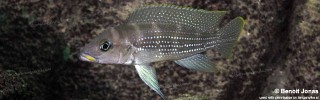
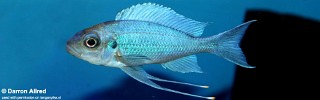
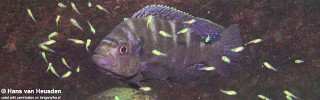
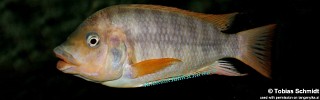
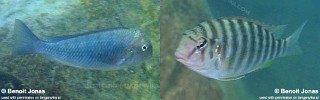
Two main color patterns are described. Males show a bright white to
bluish ground color with five vertical black to dark-blue bars, while
females are gray to dark-brown with only faintly visible bars.
Biotope:
Mainly associated with rocky to intermediate habitats. Occurs over a
broad depth range from about 3 meters down to 40 meters or deeper.
Diet:
A specialized scale-eater feeding primarily on scales of cichlids and
mastacembelid eels. A portion of stomach contents has been reported to
consist of fish skin, possibly associated with feeding on eels.
At least four hunting approaches have been described—pursuing, waiting,
mingling, and aiming—while the attack is characterized by a rapid lateral
burst with the mouth opening wide so the curved teeth can remove scales
before the victim escapes.
Breeding:
Described as a biparental mouthbrooder. The female incubates eggs and
larvae (up to about 100 eggs reported), and after the first release the
fry are cared for by both parents for an extended period.
Fry may shelter inside the parents’ mouths for more than a month after
first release. Breeding males progressively darken during parental
activities and may become very similar in coloration to females when
actively sheltering fry, with size being the main visible distinction.
Special notes:
Its coloration has been reported to closely match local forms of
Cyphotilapia frontosa, and it has been suggested this resemblance
may facilitate close approach to prey within the rocky habitat. However,
it has been observed attacking other cichlids as well, including
Cyathopharynx furcifer and Neolamprologus pulcher, and it has
been questioned whether it specifically targets C. frontosa.



At least four hunting approaches have been described—pursuing, waiting, mingling, and aiming—while the attack is characterized by a rapid lateral burst with the mouth opening wide so the curved teeth can remove scales before the victim escapes.
Fry may shelter inside the parents’ mouths for more than a month after first release. Breeding males progressively darken during parental activities and may become very similar in coloration to females when actively sheltering fry, with size being the main visible distinction.
Photo gallery