Tembwe (Deux), Lake Tanganyika, Democratic Republic of Congo
Biotope:
Rocky habitat. Most individuals are found in deeper water at
around 40 m, but the species can also occur very shallow, down to
approximately 3 m. Unlike sand-dwelling Xenotilapia species that
form large groups, this species lives in pairs, except for juveniles.
Geographic distribution:
Found between Kanoni and Tembwe (Deux) in the Democratic Republic
of Congo. A similar form, referred to on this site as
Xenotilapia cf. papilio, occurs between Kapampa (D.R. Congo) and
Katete (Zambia).
Typical adult size:
Up to approximately 10 cm total length.
Recommended aquarium size:
300 L
Aquarium setup:
A minimum aquarium length of 130 cm is recommended. The aquarium
should contain plenty of rocks forming caves and visual barriers, with
fine sand on the bottom. Due to strong intraspecific aggression, keeping
a single pair is preferred. Water quality must be high and stable, with
regular water changes. Suitable tankmates include other calm Tanganyikan
cichlids such as some Xenotilapia, Paracyprichromis and
smaller Neolamprologus.
Diet:
Omnivorous. Stomach analyses show that at least 90% of the diet
consists of small ostracods, with the remainder made up of copepods,
other small invertebrates and algae scraped from rock surfaces.
Breeding:
Biparental mouthbrooder. Spawning usually takes place on sand close
to rocks. The female broods the eggs and larvae for the first 8–12 days,
after which they are transferred to the male. Fry are released about
three weeks after spawning and are guarded by both parents for an
additional two weeks. Clutch size is small, rarely exceeding 20 eggs.
Aggression:
One of the more aggressive and territorial species of
Xenotilapia, especially toward conspecifics.
Special notes:
One of the few Xenotilapia species adapted to rocky
habitats rather than open sand. Xenotilapia sp. 'papilio katete' was previously regarded as a
distinct species. It is now considered to belong to
Xenotilapia papilio, but as a precaution this geographic variant,
occurring between Kapampa and Katete, is referred to on this site as
Xenotilapia cf. papilio until it is fully confirmed that it
represents the same species. Xenotilapia papilio differs from
Xenotilapia cf. papilio by the presence of black spots on the
pelvic fins. These spots are absent in X. cf. papilio as well as
in another similar taxon regarded here as a separate species,
Xenotilapia sp. 'papilio sunflower'.
Xenotilapia cf. papilio can further be distinguished from both
X. papilio and X. sp. 'papilio sunflower' by its light
blue pelvic fins, whereas the pelvic fins of the other two taxa are
yellow.
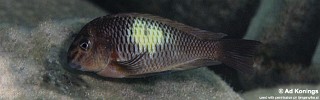
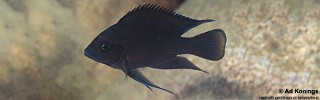
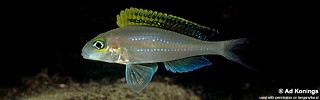




Xenotilapia sp. 'papilio katete' was previously regarded as a distinct species. It is now considered to belong to Xenotilapia papilio, but as a precaution this geographic variant, occurring between Kapampa and Katete, is referred to on this site as Xenotilapia cf. papilio until it is fully confirmed that it represents the same species.
Xenotilapia papilio differs from Xenotilapia cf. papilio by the presence of black spots on the pelvic fins. These spots are absent in X. cf. papilio as well as in another similar taxon regarded here as a separate species, Xenotilapia sp. 'papilio sunflower'. Xenotilapia cf. papilio can further be distinguished from both X. papilio and X. sp. 'papilio sunflower' by its light blue pelvic fins, whereas the pelvic fins of the other two taxa are yellow.
Photo gallery