Intermediate sand–rock habitats, with the fish remaining close to rocky structures. It inhabits
moderately deep to deep zones at depths of approximately 15–45 m, and has also been found in rocky
patches surrounded by sand several hundred metres offshore. Crevices inhabited by the fish may
exceed 60 cm in depth.
Geographic distribution:
Western coast of the Democratic Republic of Congo. The form has so far only been recorded from
Kanoni and Kapampa, south of Moba.
Typical adult size:
No precise data are available. Based on available observations and comparisons with closely
related species, it has been suggested that it reaches at least about 15 cm total length.
Recommended aquarium size:
300 L (for a group aquarium).
Aquarium setup:
No direct aquarium experience is documented. Requirements are considered comparable to those
of N. pectoralis and N. nigriventris, with rock structures combined with sandy areas.
Diet:
Carnivorous. Digestive-tract analyses revealed mainly animal food, including shrimps,
copepods, insect larvae, and snail flesh, but also contained plant tissue and sand.
Breeding:
No data are available. Reproductive behaviour has been suggested to be similar to that of the
closely related N. pectoralis and N. nigriventris.
Aggression:
No specific observations are available. Aggressive behaviour has been suggested to be similar
to that of N. pectoralis and N. nigriventris.
Special notes:
Neolamprologus sp. ‘pectoralis elongate’ is a slender member of the
Neolamprologus leleupi group and shows a combination of characters seen in
N. pectoralis and N. nigriventris. It shares the dark coloration and large pectoral
fins with N. pectoralis, while the head and body shape are more reminiscent of
N. nigriventris.
The form has so far only been documented photographically, notably by Ad Konings, who illustrated it
in 1998 under the name N. pectoralis. Based on morphology and coloration, it has been
interpreted either as an intermediate species between N. pectoralis and
N. nigriventris, or as a natural hybrid between these two species.
Ad Konings (2015) regarded this form as a geographical variant of N. nigriventris.
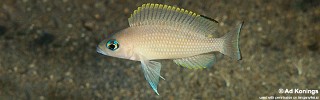
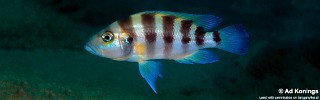
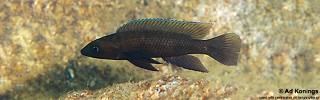
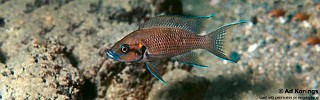
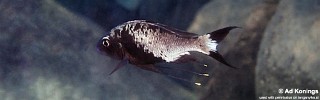



The form has so far only been documented photographically, notably by Ad Konings, who illustrated it in 1998 under the name N. pectoralis. Based on morphology and coloration, it has been interpreted either as an intermediate species between N. pectoralis and N. nigriventris, or as a natural hybrid between these two species.
Ad Konings (2015) regarded this form as a geographical variant of N. nigriventris.
Photo gallery