Bay immediately south of Cape Tembwe, Lake Tanganyika, Zaire.
Biotope:
Deep, sediment-covered rocky habitats; also occurs in intermediate and shallower zones.
Found at depths ranging from approximately 5 to 100 meters.
Geographic distribution:
Distributed around the entire shoreline of Lake Tanganyika, with no clearly recognized
geographical races reported.
Typical adult size:
Males reach about 31 cm total length. Females are approximately 25–40% smaller and rarely
exceed 20 cm total length.
Sexual dimorphism:
Sexes are similar in appearance; males are larger than females.
Recommended aquarium size:
At least 700 L, with a minimum tank length of 2 meters.
Aquarium setup:
Due to its very large size, need for a spacious aquarium, and relatively plain beige
coloration, this species is rarely kept in aquaria. The aquarium should be at least 2 meters long, with a large
rock structure in the background arranged to form caves and passages, and fine sand in the foreground. It
should only be kept with other sufficiently large Lake Tanganyika cichlids, as smaller fish will be preyed
upon.
Diet:
Carnivorous predator. In nature it mainly feeds on young fishes of other cichlids,
particularly species of the genus Cyprichromis. In the aquarium, it should be offered various live and frozen
foods such as fish and crustaceans.
Breeding:
An open-substrate spawner breeding in rocky habitats. Spawning typically occurs a few days
before the full moon, likely to improve egg defense against nocturnal predators. Eggs are deposited openly on a
large vertical or horizontal rock and are not hidden. Unlike Lepidiolamprologus elongatus, only the female
guards the eggs, reflecting the harem-based breeding system of this species. The male usually leaves after one
or two days and may spawn with other females within the same lunar cycle, with harems typically consisting of
up to four females. After three to four days, the female moves the eggs into a narrow cave entrance, which she
guards with her body.
Aggression:
Highly aggressive, especially toward conspecifics, and also aggressive toward other fish
species.
Special notes:
Characterized by relatively small eyes in proportion to its very large body size. Often
found in the same areas as Lepidiolamprologus elongatus, but usually inhabits deeper water and occurs at lower
population densities. A closely related species, Lepidiolamprologus mimicus (formerly known as Lepidiolamprologus
sp. 'profundicola tanzania'), becomes increasingly similar with age, leading to hypotheses that it may have
evolved from Lepidiolamprologus profundicola. All three species may occur sympatrically in parts of the lake.
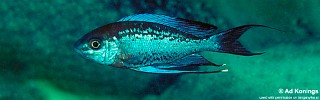
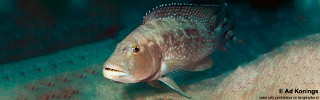
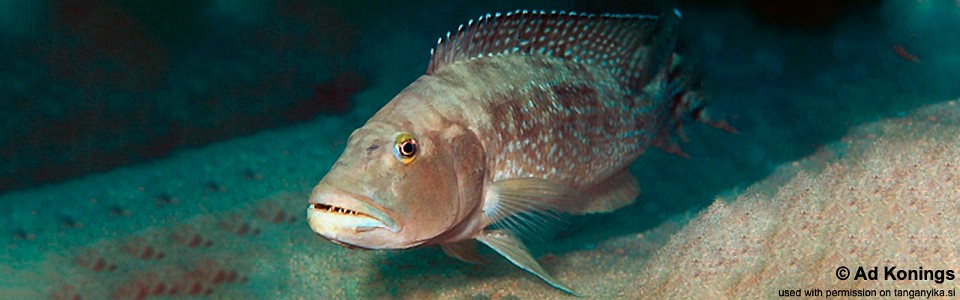



Photo gallery