Sediment-rich intermediate sand-rock habitats at depths between
6 and 30 m. One of the most secretive lamprologines, remaining close to
rocky crevices and rarely venturing far from shelter.
Geographic distribution:
Southern part of Lake Tanganyika, occurring along the western
Congolese coast south of Cape Tembwe and along the entire Zambian shoreline.
On the eastern Tanzanian coast it is found south of Wampembe.
Typical adult size:
Males reach about 8 cm TL in the lake (up to 9–10 cm in aquarium),
females remain smaller at around 6 cm TL.
Sexual dimorphism:
Males are larger and usually darker colored than females.
Recommended aquarium size:
150 L for a formed pair.
Aquarium setup:
Fine sand substrate combined with rock structures forming numerous
caves and crevices. Due to strong intraspecific aggression it is best kept
as a single pair, though it may be housed in larger community aquaria with
adequate space and structure.
Diet:
Carnivorous, feeding on small invertebrates such as crustaceans,
insect larvae and, to a lesser extent, snails.
Breeding:
Cave spawner. Egg clutches are relatively small, usually around
20 eggs. Both parents participate in brood care, with the female guarding
eggs and fry inside the cave and the male defending the entrance. Juveniles
are light brown with two horizontal stripes, which fade in adults.
Aggression:
Highly aggressive towards conspecifics.
Special notes:
Neolamprologus obscurus shows a flattened, deep-bodied appearance
reminiscent of Altolamprologus compressiceps or
Neolamprologus savoryi, though it is not closely related to either.
Its closest ecological and behavioral analogue is N. niger, which
replaces it in the northern part of the lake. The species belongs to the
broader Neolamprologus leleupi species group, sharing their secretive
lifestyle, low population density and strong territoriality.
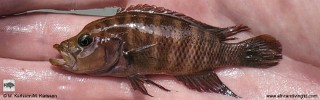
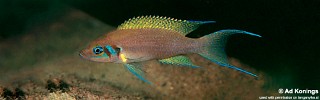



Photo gallery