Rocky habitats throughout Lake Tanganyika,
often also occurring in intermediate zones.
Usually found at depths between 5 and 50 m,
but confirmed records exist from depths down to about 200 m.
Geographic distribution:
Occurs all around Lake Tanganyika,
with no clearly defined geographical variants.
Typical adult size:
Males reach up to about 20 cm total length.
Females are roughly 20% smaller.
Sexual dimorphism:
Limited.
Sexes are alike in coloration and shape,
males being considerably larger than females.
Recommended aquarium size:
At least 500 L,
with a minimum tank length of around 200 cm.
Aquarium setup:
Fine sand substrate combined with large rocks
forming solid structures and hiding places.
Best kept as a bonded pair.
In large community aquaria,
only other large Tanganyika cichlids
should be considered as tankmates.
Diet:
Strictly carnivorous and highly piscivorous.
With an intestine only about 40% of body length,
it feeds mainly on smaller fishes,
especially Cyprichromis species and Neolamprologus brichardi.
Any fish smaller than roughly half its length
may be taken as prey.
Breeding:
Substrate spawner in rocky habitats,
usually at depths between 7 and 25 m.
Spawning often occurs a few days before full moon.
Eggs are deposited openly on vertical rock surfaces
and are not hidden.
Both parents guard the clutch and fry,
often for 3 to 4 months.
Clutch size is large, commonly around 1000 eggs.
Aggression:
Very aggressive,
both toward conspecifics and other species.
Aggression is extreme during spawning and brood care,
and females may even attack the male
while defending offspring.
Special notes:
One of the largest and most powerful members
of the genus.
Closely related to Lepidiolamprologus profundicola,
from which it differs by coloration,
eye proportions, and usually smaller adult size.
Adults may form large hunting groups in the wild,
devastating prey populations along their path.
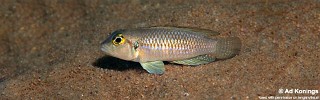
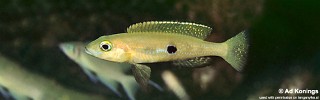
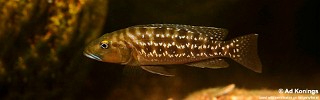
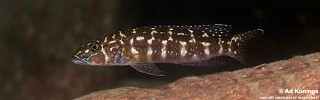
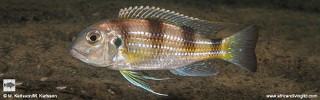



Photo gallery