Intermediate habitat close to rocky areas. Males establish lek-breeding
territories on sandy substrate, typically at depths between 3 and 25 m.
Geographic distribution:
Southern Lake Tanganyika. In the Democratic Republic of Congo recorded south to
at least Bwasa (near Zongwe), possibly extending to Moba. Along the Tanzanian
coast occurring north to Lyamembe. Present along the entire Zambian shoreline.
The distribution overlaps locally with other Cyathopharynx species.
Along the southern Congolese and Zambian shores into Tanzania up to Samazi,
C. furcifer occurs together with C. sp. 'Neon Streak'. Between
Samazi and the Maleza Hill area, C. furcifer is the only species present.
Between Maleza Hill and Wampembe it co-occurs with C. sp. 'Blue Flush',
while between Wampembe and Mtego Bay it is again the sole species. North of
Mtego Bay to Isonga it overlaps again with C. sp. 'Neon Streak'. In the
Sibwesa area and at Lyamembe it occurs together with C. sp. 'Green Flush'.
Coexistence with other species is generally rare and localized.
Typical adult size:
Males up to about 22 cm total length; females significantly smaller, usually
around 12–15 cm.
Sexual dimorphism:
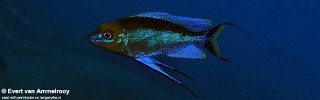
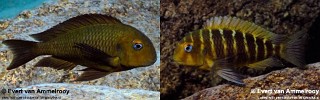
Strongly pronounced. Males are much larger and develop elongated fins,
especially the pelvic fins. Females and immature males are uniformly silvery.
Recommended aquarium size:
Minimum 500 L. Aquaria of 1000 L or more are required to maintain multiple
territorial males and allow lek-like behaviour.
Aquarium setup:
A demanding species requiring excellent water quality and careful
acclimatization. A thick layer of fine sand is mandatory for nest construction.
Rocks are optional but may help define territories.
Best kept as the dominant species in the aquarium with peaceful Tanganyikan
sand- or open-water cichlids. Fin-nipping or aggressive species must be avoided.
Slightly angled or lateral lighting enhances male coloration.
Diet:
Herbivorous. Feeds mainly on diatoms and unicellular algae from the aufwuchs.
Possesses a very long intestine typical of plant-eating Tanganyikan cichlids.
Breeding:
Maternal mouthbrooder. Males form lek-breeding arenas and construct large,
volcano-shaped sand nests. Females may spawn with multiple males during a
breeding period. Typical brood size is about 40–50 fry.
Aggression:
Territorial males can be quite aggressive when defending nesting sites,
particularly towards other males.
Special notes:
Cyathopharynx furcifer is part of a complex of closely related
Cyathopharynx species showing partially overlapping distributions.
Although it may locally occur together with other species, such coexistence is
uncommon; typically either C. furcifer or another
Cyathopharynx species dominates a given locality. The northern Tanganyikan
populations referred to as C. sp. 'Furcifer North' are considered a
separate, undescribed species and are not included here.






The distribution overlaps locally with other Cyathopharynx species. Along the southern Congolese and Zambian shores into Tanzania up to Samazi, C. furcifer occurs together with C. sp. 'Neon Streak'. Between Samazi and the Maleza Hill area, C. furcifer is the only species present. Between Maleza Hill and Wampembe it co-occurs with C. sp. 'Blue Flush', while between Wampembe and Mtego Bay it is again the sole species. North of Mtego Bay to Isonga it overlaps again with C. sp. 'Neon Streak'. In the Sibwesa area and at Lyamembe it occurs together with C. sp. 'Green Flush'. Coexistence with other species is generally rare and localized.
Photo gallery