Inhabits shallow sandy habitats. The intense coloration of males is
considered an adaptation to life in very shallow water, where wave
action stirs up sand and makes it easier for females to locate a
spawning-ready male.
Geographic distribution:
Endemic to Lake Tanganyika, with a southern distribution between
Mtoto (D.R. Congo) and Kalya (Tanzania).
Typical adult size:
Males reach a maximum size of around 14 cm, while females are
approximately 1–2 cm smaller. Juveniles grow to about 7–8 cm within
their first year and reach sexual maturity at that size.
Sexual dimorphism:
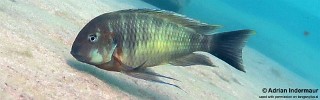
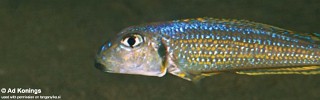
Strong sexual dimorphism typical of polygynous species. Males grow
larger than females and develop intense coloration, while females remain
silvery with only vague markings.
Recommended aquarium size:
400 L
Aquarium setup:
Dominant males can be very aggressive and territorial in the
aquarium, often attempting to defend a very large territory that may
encompass most of the tank. A harem setup is recommended, consisting of
one dominant male and several females; an additional subordinate male
may be added to stimulate more intense coloration in the dominant male.
For long-term maintenance an aquarium length of at least 150 cm is
advised.
The bottom should be covered with fine sand, with a few smooth, non-sharp
rocks placed to help define territorial boundaries. Excellent water
quality is essential and should be maintained with efficient filtration
and regular water changes.
Diet:
Carnivorous. Although no direct analysis of the digestive system has
been conducted, it is presumed to have a diet similar to the closely
related Xenotilapia ochrogenys, consisting mainly of aquatic
insect larvae, worms and small crustaceans. Feeds in a typical
Xenotilapia manner by sifting sand.
Breeding:
Maternal mouthbrooder. Males construct sand-scrape spawning sites to
attract females. Unlike Xenotilapia ochrogenys, which forms
mixed-sex schools, this species occurs in smaller groups led by a
dominant male, indicating a harem-breeding system. Females incubate eggs
and larvae for about three weeks before releasing the fry. Typical brood
size is around 40 fry.
Aggression:
Dominant males can be highly aggressive and strongly territorial,
especially in confined aquarium conditions.
Special notes:
Xenotilapia singularis was previously known as
Xenotilapia sp. 'ochrogenys ndole' before being formally
described in 2007. It is morphologically very similar to
Xenotilapia ochrogenys, but the two species differ clearly in
male coloration and distribution.
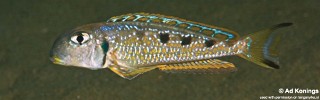
Males of X. singularis develop 3–5 conspicuous black blotches on
the flanks, which are absent in X. ochrogenys. The latter
inhabits the northern two thirds of the lake, while
X. singularis occurs in the southern part; both species are
sympatric around Kalya (Tanzania) and overlap between Kalubamba and
Mtoto on the Congolese coast.
The name “Mzuri”, commonly used in the aquarium hobby, does not refer to
a specific locality in Lake Tanganyika but is a Swahili word meaning
“beautiful”, and has been applied to certain populations of this species.



The bottom should be covered with fine sand, with a few smooth, non-sharp rocks placed to help define territorial boundaries. Excellent water quality is essential and should be maintained with efficient filtration and regular water changes.
Males of X. singularis develop 3–5 conspicuous black blotches on the flanks, which are absent in X. ochrogenys. The latter inhabits the northern two thirds of the lake, while X. singularis occurs in the southern part; both species are sympatric around Kalya (Tanzania) and overlap between Kalubamba and Mtoto on the Congolese coast.
The name “Mzuri”, commonly used in the aquarium hobby, does not refer to a specific locality in Lake Tanganyika but is a Swahili word meaning “beautiful”, and has been applied to certain populations of this species.
Photo gallery