Julidochromis sp. 'transcriptus tanzania' Kalepa Island
Tribe / Genus:
Lamprologini / Julidochromis
Type locality:
Mpando Point (north of Samazi) to Kilewani (south of Kasanga),
southeastern Tanzanian coast of Lake Tanganyika.
Biotope:
Shallow to moderately deep coastal habitats, from rocky to intermediate
sand–rock zones.
Geographic distribution:
Southeastern Tanzanian coast of Lake Tanganyika, from Mpando Point
(north of Samazi) to Kilewani (south of Kasanga).
Typical adult size:
9–11 cm total length, placing this population among the larger members
of the Julidochromis ornatus species group.
Sexual dimorphism:
No sexual dichromatism. Males are usually slightly larger than females.
Recommended aquarium size:
200–300 liters for a group; established pairs may be kept in smaller aquaria.
Aquarium setup:
Rocky to intermediate setup with fine sand substrate, numerous crevices
and shelters. Visual barriers are essential due to high intraspecific aggression.
Diet:
Invertebrate feeder. Small animals are picked from algal cover and rock
crevices. Readily accepts flakes, pellets, and small crustaceans
(Artemia, Cyclops).
Breeding:
Breeding occurs more or less continuously throughout the year.
Clutch size ranges from a few eggs to several dozens, remaining lower
than in the Julidochromis regani species group.
Pairs are usually monogamous, though polygyny may occur in aquarium.
Older juveniles may remain temporarily as “satellites” until reaching
approximately 3 cm, after which they are expelled.
Aggression:
High intraspecific aggression. Territorial and intolerant toward
similar-sized lamprologines without sufficient space and structure.
Special notes:
Karlsson & Karlsson (2018) describe a characteristic checkered
black-and-white melanic pattern with white to yellow or orange blotches
between black markings. In contrast to northern Congolese
Julidochromis transcriptus and the Kapampa populations, the
black markings typically extend onto the lower body and cheeks.
However, this feature overlaps with populations from Kalemie, Katoto,
and Kombe.
Two phenotypes are observed: a strongly checkered “transcriptoid” form
and a more yellow-lined form. Color pattern and the amount of yellow
pigmentation are strongly influenced by habitat structure and light
conditions.
The taxonomic status of this population remains unresolved.
While Karlsson & Karlsson (2018) suggest conspecificity with
transcriptus-like populations from Zambia, clear evidence for reproductive
isolation is lacking. Until further research is available, this population
is treated here as a distinct, undescribed species.
Ad Konings and Cichlidae.com use the name
Julidochromis sp. ‘ornatus muzi’ for this population,
which is treated here under the name
Julidochromis sp. ‘transcriptus tanzania’.
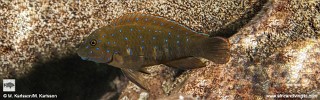
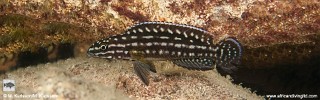
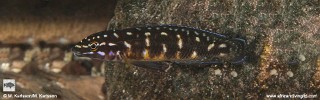
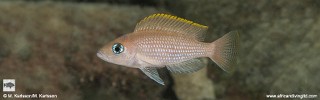
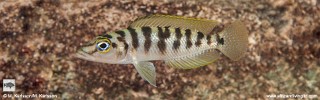



Two phenotypes are observed: a strongly checkered “transcriptoid” form and a more yellow-lined form. Color pattern and the amount of yellow pigmentation are strongly influenced by habitat structure and light conditions.
The taxonomic status of this population remains unresolved. While Karlsson & Karlsson (2018) suggest conspecificity with transcriptus-like populations from Zambia, clear evidence for reproductive isolation is lacking. Until further research is available, this population is treated here as a distinct, undescribed species.
Ad Konings and Cichlidae.com use the name Julidochromis sp. ‘ornatus muzi’ for this population, which is treated here under the name Julidochromis sp. ‘transcriptus tanzania’.
Photo gallery