Occupies rocky habitats and likely also intermediate sand–rock environments, restricted to greater
depths. Territorial males are found deeper than 20 m, where territories are only weakly defended, while females
occur at somewhat shallower depths of about 10–15 m and do not hold territories.
Geographic distribution:
Occurs in the southernmost part of Lake Tanganyika, confirmed at Kasenga in Zambia, and is likely
distributed further both eastwards and westwards along the southern basin of the lake.
Typical adult size:
Little is known about adult size. In the type series, the largest specimen was a female measuring
about 14 cm. Males are assumed to be significantly larger than females, as in other members of the species
group, but confirmed observations of fully adult males are lacking.
Sexual dimorphism:
Poorly documented. Available material suggests females are smaller, while males are presumed to be
larger, although this has not yet been directly observed.
Recommended aquarium size:
An aquarium of at least 500 L is recommended.
Aquarium setup:
Provide extensive rockwork arranged into separate rock piles to create loosely defined territories,
while maintaining ample open swimming space between structures. A sandy substrate is recommended.
Strong filtration is essential due to the large amount of food consumed and the resulting waste production.
Diet:
Herbivorous grazer. In nature it feeds mainly on algae scraped from rocks. In aquaria, it should be
offered a diet rich in vegetable matter, particularly spirulina-based flakes or pellets.
Breeding:
Maternal mouthbrooder.
The male attracts the female to his territory, where spawning occurs. Eggs are collected into the female’s
mouth, and fertilization takes place inside the mouth during interaction with the male’s egg spots.
Broods are relatively small, usually around 15 eggs in nature and often around 30 in aquaria. After roughly
30 days the female releases well-developed fry and continues feeding during the brooding period.
Aggression:
Generally aggressive toward conspecifics, though members of the Petrochromis horii species
group are notably less aggressive than shallow-water Petrochromis. This reduced aggression is likely related
to their deep-water habitat. Toward other species, aggression is limited, although males may weakly defend
territories.
Special notes:
Petrochromis horii belongs to the so-called Petrochromis horii species group, referred to by
Ad Konings as “Petrochromis of the deep”. According to African Diving Ltd, this group comprises four distinct species.
Because these Petrochromis inhabit depths greater than 20 m (with territorial
males occurring even deeper), all members of the group remain poorly studied.
Members of the P. horii species group are distributed throughout the southern part of Lake Tanganyika,
occurring along the central Tanzanian coast in Mahale National Park, continuing along the entire southern
Tanzanian shoreline, through Zambia, and further along the southern Congolese coast as far as Cape Tembwe
(according to African Diving Ltd). Exact distribution boundaries between the individual species of the group
are largely unresolved due to their deep-water habitat and the resulting lack of comprehensive observations.
The group currently includes the following forms:
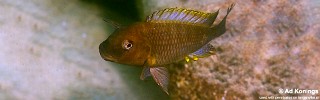
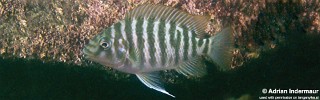
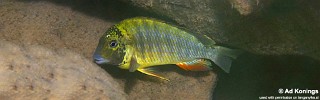
Petrochromis horii – the only formally described species of the group, yet arguably the least
known. Apart from photographs by Adrian Indermaur from Kapwensolo and Kalambo Lodge, very few images exist
beyond those used for the original description. The species was described from specimens collected at
Kasenga, Zambia, where the largest individual was a female measuring about 14 cm. Takahashi & Koblmüller
(2014) therefore suggested the possibility of females being larger than males, a hypothesis P. Tawil
considers highly unlikely, maintaining that males are probably substantially larger, although this remains
undocumented. Apart from the mentioned Zambian localities in the extreme south-eastern part of the lake,
no confirmed records from other areas exist.
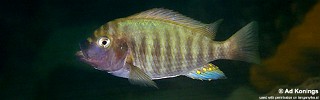
Petrochromis sp. ‘gold’ – included within P. horii by Ad Konings in Tanganyika
Cichlids in their Natural Habitat (4th edition), although he notes that further research may show it to
represent a distinct species. According to Konings (2019), it occurs from Katete in Zambia to Mtoto in the
Democratic Republic of the Congo, while African Diving Ltd report its presence as far as Cape Tembwe. The
name refers to the bright yellow coloration seen in subadult individuals; adult males are instead grey with
vertical barring.
Petrochromis sp. ‘red’ – found in the area between Lyamembe and the Lubulungu River.
With the exception of Lyamembe, which lies just outside Mahale National Park at the southern edge of the
range, the entire distribution is located within Mahale NP. In the aquarium hobby,
this species is often incorrectly referred to as Petrochromis sp. 'Red’ Bulu Point',
although it does not occur at Bulu Point. The use of this locality name is likely
related to fishing restrictions within Mahale Mountains NP, with Bulu Point being just north
of the protected area. The species is also sometimes mislabeled as originating from
Sibwesa, but no suitable habitat exists there and the species does not occur at that
location.
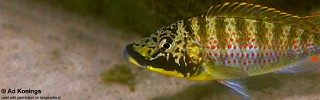
Petrochromis sp. ‘red mpimbwe’ – the name used by African Diving Ltd; referred to by Ad Konings as
P. sp. ‘kipili brown’, and by P. Tawil simply as P. sp. ‘brown’, all three names referring
to the same form. This taxon is reported from Cape Mpimbwe southwards to Kambwimba, slightly north of the
Kalambo River. Specimens from the Kambwimba and Kasanga areas are commonly known in the aquarium hobby as
“Petrochromis Flametail”. African Diving Ltd and Ad Konings consider “Flametail” conspecific with
P. sp. ‘red mpimbwe’ (= P. sp. ‘kipili brown’), whereas P. Tawil suggests Flametail may be
closer to P. horii. This discussion is detailed by P. Tawil in “The deep-water Petrochromis”
(Tanganyika Magazyn, issue 20).
All four members of this group share a deep-water lifestyle and one particularly rare trait among Tropheini:
the absence of false egg spots on the anal fin.



Strong filtration is essential due to the large amount of food consumed and the resulting waste production.
The male attracts the female to his territory, where spawning occurs. Eggs are collected into the female’s mouth, and fertilization takes place inside the mouth during interaction with the male’s egg spots.
Broods are relatively small, usually around 15 eggs in nature and often around 30 in aquaria. After roughly 30 days the female releases well-developed fry and continues feeding during the brooding period.
Members of the P. horii species group are distributed throughout the southern part of Lake Tanganyika, occurring along the central Tanzanian coast in Mahale National Park, continuing along the entire southern Tanzanian shoreline, through Zambia, and further along the southern Congolese coast as far as Cape Tembwe (according to African Diving Ltd). Exact distribution boundaries between the individual species of the group are largely unresolved due to their deep-water habitat and the resulting lack of comprehensive observations.
The group currently includes the following forms:
- Petrochromis horii – the only formally described species of the group, yet arguably the least
known. Apart from photographs by Adrian Indermaur from Kapwensolo and Kalambo Lodge, very few images exist
beyond those used for the original description. The species was described from specimens collected at
Kasenga, Zambia, where the largest individual was a female measuring about 14 cm. Takahashi & Koblmüller
(2014) therefore suggested the possibility of females being larger than males, a hypothesis P. Tawil
considers highly unlikely, maintaining that males are probably substantially larger, although this remains
undocumented. Apart from the mentioned Zambian localities in the extreme south-eastern part of the lake,
no confirmed records from other areas exist.
- Petrochromis sp. ‘gold’ – included within P. horii by Ad Konings in Tanganyika
Cichlids in their Natural Habitat (4th edition), although he notes that further research may show it to
represent a distinct species. According to Konings (2019), it occurs from Katete in Zambia to Mtoto in the
Democratic Republic of the Congo, while African Diving Ltd report its presence as far as Cape Tembwe. The
name refers to the bright yellow coloration seen in subadult individuals; adult males are instead grey with
vertical barring.
- Petrochromis sp. ‘red’ – found in the area between Lyamembe and the Lubulungu River.
With the exception of Lyamembe, which lies just outside Mahale National Park at the southern edge of the
range, the entire distribution is located within Mahale NP. In the aquarium hobby,
this species is often incorrectly referred to as Petrochromis sp. 'Red’ Bulu Point',
although it does not occur at Bulu Point. The use of this locality name is likely
related to fishing restrictions within Mahale Mountains NP, with Bulu Point being just north
of the protected area. The species is also sometimes mislabeled as originating from
Sibwesa, but no suitable habitat exists there and the species does not occur at that
location.
- Petrochromis sp. ‘red mpimbwe’ – the name used by African Diving Ltd; referred to by Ad Konings as
P. sp. ‘kipili brown’, and by P. Tawil simply as P. sp. ‘brown’, all three names referring
to the same form. This taxon is reported from Cape Mpimbwe southwards to Kambwimba, slightly north of the
Kalambo River. Specimens from the Kambwimba and Kasanga areas are commonly known in the aquarium hobby as
“Petrochromis Flametail”. African Diving Ltd and Ad Konings consider “Flametail” conspecific with
P. sp. ‘red mpimbwe’ (= P. sp. ‘kipili brown’), whereas P. Tawil suggests Flametail may be
closer to P. horii. This discussion is detailed by P. Tawil in “The deep-water Petrochromis”
(Tanganyika Magazyn, issue 20).
All four members of this group share a deep-water lifestyle and one particularly rare trait among Tropheini: the absence of false egg spots on the anal fin.Photo gallery