Deep water habitats. Lives at depths from approximately 30 to 100 m, and possibly deeper.
Geographic distribution:
Widespread throughout Lake Tanganyika, but nowhere abundant.
Typical adult size:
Males up to about 20 cm, females usually around 18 cm.
Sexual dimorphism:
None, except that males are usually slightly larger than females.
Recommended aquarium size:
Minimum 500 L.
Aquarium setup:
Fine to medium-grained sand substrate is essential. A few rocks should be placed in the
background to form passages and caves. This is a relatively peaceful species and should
not be kept with aggressive cichlids. Suitable tankmates include large, calm species such
as Cyphotilapia.
Diet:
Carnivorous. In the wild feeds mainly on zooplankton and tiny benthic invertebrates.
In aquaria it readily accepts frozen foods. Feeding behaviour is highly specialized:
the strongly protractile mouth functions like a vacuum cleaner, sucking prey from the
substrate.
Breeding:
Biparental mouthbrooder. Both parents alternate carrying the brood every 2–3 days,
which prevents prolonged starvation of either parent. Fry are released after
approximately two weeks. Even after release, both parents guard the young and may
take them back into the mouth if danger threatens.
Aggression:
Relatively peaceful. Defends a territory, but usually without excessive aggression.
Special notes:
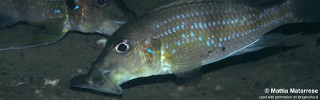
Gnathochromis permaxillaris differs from other limnochromines mainly by its
elongated and angular snout. The upper lip is flattened and markedly longer than the
lower one, and the mouth is strongly protractile downward, forming a vacuum-like nozzle
used to rake the substrate.
This species inhabits muddy bottoms close to rocks, often at considerable depths.
It shows very little geographical variation across the lake, which is probably related
to the absence of strong habitat barriers at depth. Its remarkable feeding specialization
reflects the ancient and primitive nature of the Limnochromini lineage.
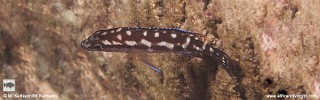





This species inhabits muddy bottoms close to rocks, often at considerable depths. It shows very little geographical variation across the lake, which is probably related to the absence of strong habitat barriers at depth. Its remarkable feeding specialization reflects the ancient and primitive nature of the Limnochromini lineage.
Photo gallery