Inhabits the shallow intermediate habitat, occupying the transition
zone between rocky and sandy areas.
Geographic distribution:
Endemic to Lake Tanganyika, occurring in the southern and central
parts of the lake.
In Tanzania it is found south of the Lubulungu River to the Kalambo
River. It occurs along the entire Zambian shoreline and in the southern
part of the D.R. Congo, at least as far north as Tembwe (Deux), and
possibly extending to Moba.
A similar taxon, referred to as Xenotilapia sp.
‘spilopterus north’, is found north of the Lubulungu River to at least
the Kigoma area. No spilopterus-like species are currently
known from Burundi or northern D.R. Congo.
Typical adult size:
Up to approximately 10 cm total length.
Recommended aquarium size:
200 L
Aquarium setup:
More robust and less strictly sand-bound than most other
Xenotilapia, making it suitable for a Lake Tanganyika
community aquarium. Suitable tankmates include smaller
Neolamprologus, Cyprichromis and shell-dwellers.
The aquarium should contain some rocks, but also sufficiently large
sandy areas and open swimming space. A single pair can be kept in an
aquarium of 100 cm length; when housed together with other species, a
minimum length of 120 cm is recommended.
Diet:
Carnivorous. In nature it mainly feeds on insect larvae by sifting
sand in a manner typical for Xenotilapia. It may also form
large midwater schools feeding on zooplankton. In the aquarium it
readily accepts frozen foods such as cyclops, insect larvae, artemia
and small crustaceans, as well as high-quality prepared foods.
Breeding:
Biparental mouthbrooder. Outside the breeding season it lives in large
schools, but during spawning pairs separate and establish a small
territory in rocky habitat. The female incubates the eggs and larvae
for 9–12 days before transferring them to the male, who broods them for
another 6–10 days. Both parents protect the fry for several weeks after
release. Clutch size is usually around 40 fry.
Aggression:
Generally peaceful; males may occasionally show mild intraspecific
aggression.
Special notes:
The most robust species within the genus Xenotilapia and
highly recommended for aquarists new to keeping this group. Xenotilapia sp. ‘spilopterus north’, occurring north of the
Lubulungu River, is regarded by several authors as a distinct species.
It differs most easily from X. spilopterus by the coloration
of the dorsal fin: it has tiny colored spots and lacks the blotchy
markings present in all known populations of X. spilopterus.
Minor coloration differences also occur between populations of
X. spilopterus; particularly notable is a variant found
between Lyamembe and the Lubulungu River that shows an attractive yellow
coloration.



In Tanzania it is found south of the Lubulungu River to the Kalambo River. It occurs along the entire Zambian shoreline and in the southern part of the D.R. Congo, at least as far north as Tembwe (Deux), and possibly extending to Moba.
A similar taxon, referred to as Xenotilapia sp. ‘spilopterus north’, is found north of the Lubulungu River to at least the Kigoma area. No spilopterus-like species are currently known from Burundi or northern D.R. Congo.
The aquarium should contain some rocks, but also sufficiently large sandy areas and open swimming space. A single pair can be kept in an aquarium of 100 cm length; when housed together with other species, a minimum length of 120 cm is recommended.
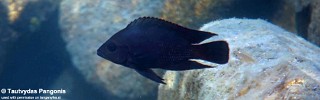
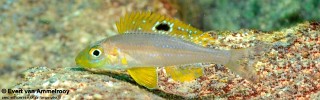
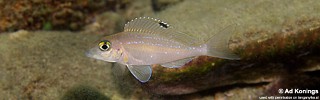
Xenotilapia sp. ‘spilopterus north’, occurring north of the Lubulungu River, is regarded by several authors as a distinct species. It differs most easily from X. spilopterus by the coloration of the dorsal fin: it has tiny colored spots and lacks the blotchy markings present in all known populations of X. spilopterus.
Minor coloration differences also occur between populations of X. spilopterus; particularly notable is a variant found between Lyamembe and the Lubulungu River that shows an attractive yellow coloration.
Photo gallery