Mtosi Bay, great rocks of south coast, Lake Tanganyika, Tanzania.
Biotope:
Rocky habitats interspersed with sandy patches, usually at depths
less than 10 meters.
Geographic distribution:
Endemic to the southern part of Lake Tanganyika, occurring between
Isanga Bay in Zambia and Kipili in Tanzania. South of Mtosi it
shares habitat with Neolamprologus modestus.
Typical adult size:
Reaches around 15 cm total length in the lake, while specimens kept
in aquaria may grow up to approximately 18 cm.
Sexual dimorphism:
Sexual dimorphism is weak. Males may be slightly larger than females,
but otherwise sexes are externally very similar. Occasional color
differences have been observed, with females sometimes appearing
paler, though this is not consistent.
Recommended aquarium size:
At least 300 liters for a formed pair.
Aquarium setup:
The aquarium should contain large rock structures forming caves,
with a bottom layer of fine sand. Each member of a pair may defend
its own cave, therefore a spacious tank is required. Due to its
relatively large size and powerful bite, it can coexist with most
Tanganyika cichlids except for some larger lamprologine species.
Diet:
Carnivorous. Feeds mainly on invertebrates; gut content analyses have
revealed crustaceans, worms, and small snails.
Breeding:
The pair excavates a cavity near rocks where a large clutch of more
than 250 eggs is deposited, though the number of surviving fry is
usually below 100. In aquaria, each partner often maintains its
own cave, joining occasionally. Fry are most often guarded by the
female, suggesting a possible harem-like system, while field
observations have also documented pairs jointly defending fry,
indicating that monogamy may also occur.
Aggression:
An extremely aggressive species, both towards conspecifics and other
fishes. Its strong territorial behavior necessitates a large
aquarium.
Special notes:
Neolamprologus christyi is closely related to members of the
N. petricola and N. mondabu group, sharing similar
morphology but differing by a more elongated body, a distinctly
crescent-shaped caudal fin, a higher number of body scales, and
markedly stronger aggressiveness. Juveniles are beige with blue
edging on the dorsal and caudal fins, while adults become matte
black to dark chocolate brown. Despite its forked tail and slender
shape, it is not related to Neolamprologus furcifer.
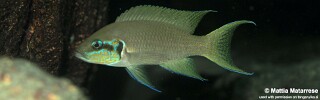
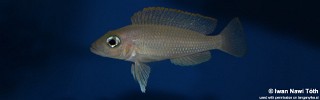
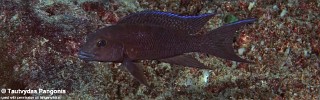
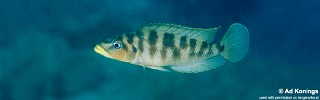
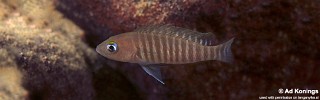



Photo gallery