Open water of deep rocky shores. Occurs in large schools, often together
with Cyprichromis pavo (or C. microlepidotus),
C. leptosoma, Paracyprichromis nigripinnis and
P. brieni.
Geographic distribution:
Southern Lake Tanganyika. On the western shore found from south of Moba
(probably from Mulunguzi, the first rocky habitat south of Moba) and
further south along the Congolese coast; also present along most of the
Zambian shoreline, except between Chituta and Kapembwa.
On the eastern shore found between the Kalambo River and Isonga; absent
from the Mahale Mountains area.
Typical adult size:
Up to about 12 cm total length.
Recommended aquarium size:
Minimum 400 L
Aquarium setup:
The aquarium should provide plenty of open swimming space with only a
limited number of rocks for orientation and shelter. Substrate choice
is not important, as the species neither feeds nor spawns on the bottom.
This species should be kept in groups of at least 12 individuals.
Due to its relatively high level of aggression and territorial behaviour,
it should not be kept with delicate sand-dwelling species (most
Xenotilapia are unsuitable). More robust sand-dwellers such as
Callochromis are better companions.
It should also not be kept with large piscivorous cichlids such as
Cyphotilapia. A tight-fitting cover is required, as these fish
are prone to jumping.
Diet:
Carnivorous planktivore. In nature feeds mainly on zooplankton, which is
captured with the highly protrusible mouth. In the aquarium it accepts
most foods, but live food (small crustaceans, plankton) is preferred and
enhances coloration.
Breeding:
Maternal mouthbrooder. During spawning, the male holds a three-dimensional
territory in open water and courts passing females by curving the body
and vibrating the pelvic fins. Eggs are released individually and
immediately taken into the female’s mouth.
Clutch size is usually between 8 and 12 eggs, but may reach up to about
20. The female broods the eggs for approximately four weeks.
Aggression:
Can be quite aggressive and territorial in the aquarium, especially
during breeding.
Special notes:
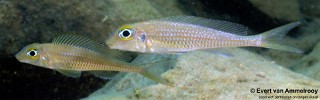
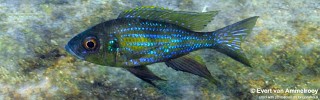
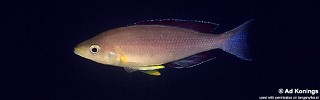
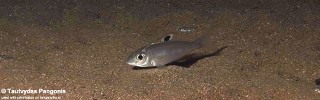
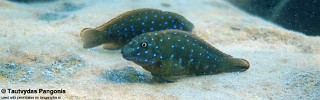
Cyprichromis sp. 'leptosoma jumbo' is a large, deep-bodied member
of the genus and is often confused with C. leptosoma. It can be
easily distinguished by the absence of the brilliant blue sheen on the
head, its deeper body, and its larger adult size (up to 12 cm, whereas
C. leptosoma rarely exceeds 9 cm).
Males are strongly polymorphic, with several colour morphs occurring
within the same population. Six geographical variants are
recognised:
Kekese – Found between Isonga and Karema (Tanzania). Males
with black dorsal fins lack a golden-yellow head; males with light blue
dorsal fins lack a black spot on the fin.
Malasa – The most widespread variant, occurring from
Karema to the Kalambo River. Males with black dorsal fins have a golden-
yellow head; males with light blue dorsal fins show a black spot on the
anterior part of the dorsal fin.
Kapembwa / Isanga – Found along the eastern shore of
Chituta Bay and between Nzwema and Kapembwa. Males have a black dorsal fin
with a thin yellow line along its lower edge and either yellow or blue
caudal fins; the lower part of the head is golden yellow.
Chaitika / Moliro – Occurs between Cape Chaitika and
Nkamba Bay, and between Chimba and Moliro (possibly extending north to
Lunangwa). Males have light blue dorsal fins and yellow or blue caudal
fins; head coloration differs between morphs.
Cape Kachese – Restricted to the Cape Kachese area.
Males show either black anal fins with yellow caudal fins or light blue
anal and caudal fins; all morphs have a golden-yellow lower head. This
was the first variant exported for the aquarium trade.
Kapampa – Found between Lunangwa and Moba. Males have
yellow-blue dorsal fins and either yellow or blue caudal fins; the lower
head is orange-yellow.



On the eastern shore found between the Kalambo River and Isonga; absent from the Mahale Mountains area.
This species should be kept in groups of at least 12 individuals. Due to its relatively high level of aggression and territorial behaviour, it should not be kept with delicate sand-dwelling species (most Xenotilapia are unsuitable). More robust sand-dwellers such as Callochromis are better companions.
It should also not be kept with large piscivorous cichlids such as Cyphotilapia. A tight-fitting cover is required, as these fish are prone to jumping.
Clutch size is usually between 8 and 12 eggs, but may reach up to about 20. The female broods the eggs for approximately four weeks.
Males are strongly polymorphic, with several colour morphs occurring within the same population. Six geographical variants are recognised:
Kekese – Found between Isonga and Karema (Tanzania). Males with black dorsal fins lack a golden-yellow head; males with light blue dorsal fins lack a black spot on the fin.
Malasa – The most widespread variant, occurring from Karema to the Kalambo River. Males with black dorsal fins have a golden- yellow head; males with light blue dorsal fins show a black spot on the anterior part of the dorsal fin.
Kapembwa / Isanga – Found along the eastern shore of Chituta Bay and between Nzwema and Kapembwa. Males have a black dorsal fin with a thin yellow line along its lower edge and either yellow or blue caudal fins; the lower part of the head is golden yellow.
Chaitika / Moliro – Occurs between Cape Chaitika and Nkamba Bay, and between Chimba and Moliro (possibly extending north to Lunangwa). Males have light blue dorsal fins and yellow or blue caudal fins; head coloration differs between morphs.
Cape Kachese – Restricted to the Cape Kachese area. Males show either black anal fins with yellow caudal fins or light blue anal and caudal fins; all morphs have a golden-yellow lower head. This was the first variant exported for the aquarium trade.
Kapampa – Found between Lunangwa and Moba. Males have yellow-blue dorsal fins and either yellow or blue caudal fins; the lower head is orange-yellow.
Photo gallery