Very shallow, wave-exposed rocky littoral habitat with high
oxygenation. Typically associated with rocky shorelines, sometimes including
sediment-rich areas, and rarely occurring deeper than three meters.
Geographic distribution:
Occurs along the northern part of the Tanzanian shoreline of Lake
Tanganyika, from Halembe in the south northwards through the Kigoma area.
The range continues further north into Burundi and then extends along the Congolese
shoreline southwards to the Ubwari Peninsula.
Special notes:
This taxon has been referred to in earlier literature as
Spathodus sp. 'erythrodon kigoma' and represents the same entity
currently known as Spathodus sp. 'erythrodon north'.
It is one of four sympatric goby cichlid species occurring in the
Kigoma–Halembe range, coexisting with Eretmodus marksmithi,
Eretmodus cf. cyanostictus and Tanganicodus irsacae.
Distinguished from true Spathodus erythrodon from the Mtoa–Tembwe area and
S. cf. erythrodon from the Ikola-Isonga area by a more elongated
snout often showing a conspicuous indentation between the eyes, a more
elongated and shallower body, absence of vertical body bars, presence of
rows of yellow to orange dots on the lower trunk, and typically a black
stripe rather than a single spot in the dorsal fin.
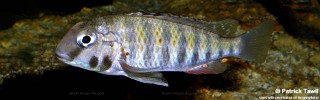
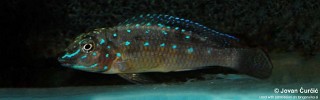
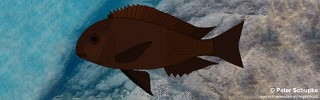



It is one of four sympatric goby cichlid species occurring in the Kigoma–Halembe range, coexisting with Eretmodus marksmithi, Eretmodus cf. cyanostictus and Tanganicodus irsacae.
Distinguished from true Spathodus erythrodon from the Mtoa–Tembwe area and S. cf. erythrodon from the Ikola-Isonga area by a more elongated snout often showing a conspicuous indentation between the eyes, a more elongated and shallower body, absence of vertical body bars, presence of rows of yellow to orange dots on the lower trunk, and typically a black stripe rather than a single spot in the dorsal fin.
Photo gallery