Deeper sandy and muddy substrates, typically found between
20 and 100 meters depth, only rarely occurring in shallower waters.
Geographic distribution:
Endemic to Lake Tanganyika, restricted to the southeastern
part of the lake, from Isonga in Tanzania southwards to Kombe in Zambia.
No sympatric occurrence with Xenotilapia bathyphilus has been
recorded.
Typical adult size:
Up to about 10 cm total length. Aquarium-reared individuals
usually reach a similar size; females remain slightly smaller than
males.
Sexual dimorphism:
As typical for maternal mouthbrooders, males grow somewhat
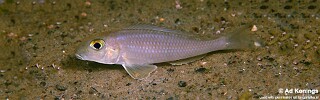
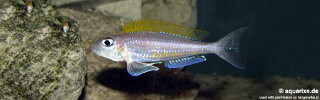
larger than females. Females are less intensely colored and appear more
silvery with subdued markings.
Recommended aquarium size:
An aquarium of at least 200 liters is recommended. Larger
tanks (minimum length around 130–150 cm) allow keeping groups with more
than one male.
Aquarium setup:
Fine sand substrate is essential. Only a few smooth rocks
should be used, leaving large open sandy areas. High water quality with
efficient filtration and regular water changes is required.
Diet:
Carnivorous. Feeds by sifting the upper layers of the substrate
for small invertebrates, expelling non-edible material through the mouth
and gills. In aquaria it readily accepts various small frozen foods and
high-quality dry foods.
Breeding:
Maternal mouthbrooder. Males do not construct sand-scrape
territories, but spawn on cleaned spots within the habitat. Clutch size
is usually 30–40 eggs. The female incubates the eggs in her mouth for
about three weeks. No post-release brood care has been observed.
Aggression:
Males can be territorial and aggressive towards conspecific
males. In smaller aquaria it is best kept as one male with several
females; multiple males require a sufficiently large tank.
Special notes:
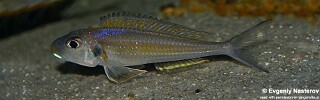
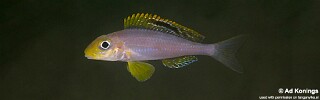
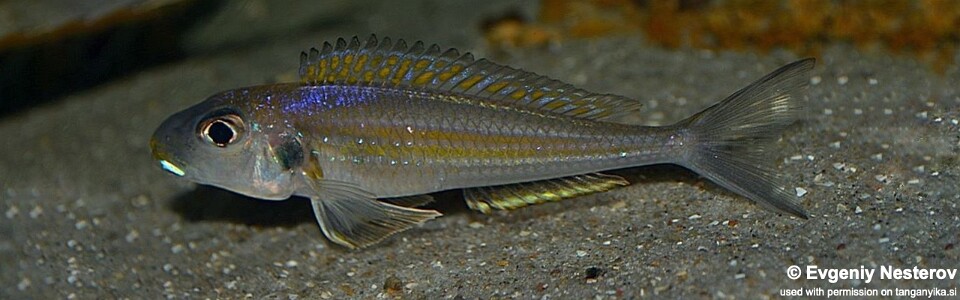
This taxon is morphologically very similar to
Xenotilapia bathyphilus, but differs in coloration and behavior.
The most reliable visual distinction is lip color: X. sp.
'bathyphilus yellow' has a yellow upper lip and snout, whereas
X. bathyphilus shows a turquoise blue upper lip.
In addition, males of this form do not build sand turrets, unlike
X. bathyphilus. The two forms have different, non-overlapping
distributions and have never been observed occurring together.




In addition, males of this form do not build sand turrets, unlike X. bathyphilus. The two forms have different, non-overlapping distributions and have never been observed occurring together.
Photo gallery