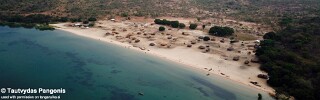
Approximately 3–4 km west of Mpulungu, Lake Tanganyika, Zambia.
Biotope:
Deep muddy habitats. Exclusively recorded from deep-water environments,
occurring at depths of at least 60 m and down to 100 m or more.
Geographic distribution:
Endemic to Lake Tanganyika. Currently confirmed from Zambian waters,
including areas near Mpulungu, Chituta Bay, and Kalambo.
The full extent of its distribution within the lake remains unclear.
Typical adult size:
Up to about 15 cm standard length
(holotype female 13.5 cm SL; largest recorded male 15.1 cm SL).
Sexual dimorphism:
No obvious external sexual dimorphism has been documented.
Diet:
Unknown. Based on jaw morphology and conical teeth,
the species is presumed to be a benthic predator.
Special notes:
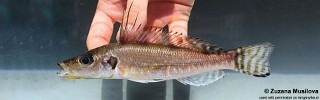
Distinguished from all other Tanganyikan cichlids by its extremely produced,
broadly flattened snout and distinctive spinous dorsal fin.
The second and third dorsal spines are markedly elongated and often filamentous.
It differs from Reganochromis calliurus by having smaller scales,
fewer dorsal spines and rays, a longer head and pectoral fins,
a more strongly projecting mandible, and a differently coloured dorsal fin.
One of the most elusive and least-known cichlids of Lake Tanganyika,
rarely encountered due to its strictly deep-water lifestyle.



It differs from Reganochromis calliurus by having smaller scales, fewer dorsal spines and rays, a longer head and pectoral fins, a more strongly projecting mandible, and a differently coloured dorsal fin.
One of the most elusive and least-known cichlids of Lake Tanganyika, rarely encountered due to its strictly deep-water lifestyle.
Photo gallery