Very shallow, wave-exposed rocky habitat with high oxygenation,
rarely deeper than three meters.
Occupies rocky and sediment-rich areas with patches of sand and natural
debris such as decaying reeds and leaves.
Geographic distribution:
Known only from Isaba Point, located approximately 10 km north of
the Kipili Archipelago on the Tanzanian shore of Lake Tanganyika.
Typical adult size:
Small goby cichlid; adult size comparable to other
Spathodus erythrodon-like species.
Sexual dimorphism:
Sexual dimorphism is weak; males and females are similar in
coloration and body shape.
Diet:
Omnivorous aufwuchs feeder.
Feeds on algae and small invertebrates scraped or picked from rocks
and sediment-rich substrates.
Breeding:
Biparental mouthbrooder, typical of goby cichlids.
The female broods eggs during the first 10–15 days, after which the
male takes over brooding of the hatched larvae for a further
10–15 days.
Aggression:
Territorial within the species, typically occurring in pairs.
Coexists locally with Eretmodus cyanostictus without clear
spatial segregation.
Special notes:
A potentially distinct, cryptic Spathodus erythrodon-like
species discovered in 2008.
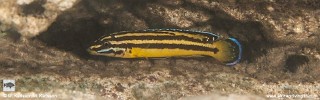
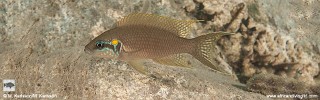
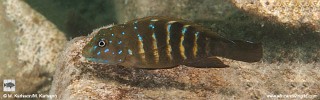
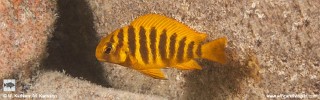
Differs from sympatric Eretmodus cyanostictus by elongated
blue dots on head and trunk, yellowish vertical bars extending across
the flank, a slightly concave snout, and a more terminal mouth.
Lacks a black dorsal fin spot and blue dorsal submargin, separating it
from S. erythrodon-like populations found in the Cape
Tembwe–Moba range (DR Congo) and the Isonga–Ikola range (Tanzania).
Considered part of a broader complex of S. erythrodon-like
forms showing strong phylogeographic structure across Lake Tanganyika.



Occupies rocky and sediment-rich areas with patches of sand and natural debris such as decaying reeds and leaves.
Feeds on algae and small invertebrates scraped or picked from rocks and sediment-rich substrates.
The female broods eggs during the first 10–15 days, after which the male takes over brooding of the hatched larvae for a further 10–15 days.
Coexists locally with Eretmodus cyanostictus without clear spatial segregation.
Differs from sympatric Eretmodus cyanostictus by elongated blue dots on head and trunk, yellowish vertical bars extending across the flank, a slightly concave snout, and a more terminal mouth.
Lacks a black dorsal fin spot and blue dorsal submargin, separating it from S. erythrodon-like populations found in the Cape Tembwe–Moba range (DR Congo) and the Isonga–Ikola range (Tanzania).
Considered part of a broader complex of S. erythrodon-like forms showing strong phylogeographic structure across Lake Tanganyika.
Photo gallery