Shallow, sediment-free rocky shores with large boulders and rocky caves, densely covered with
algae. Prefers areas with extensive flat rock surfaces suitable for effective algal grazing.
Geographic distribution:
Petrochromis sp. ‘Blue Giant’ is found between Lyamembe and Kala Bay, except for a gap between south of
Lyamembe and Kansombo where it has not yet been observed (African Diving 2019).
Typical adult size:
Exceptionally large for the genus, commonly exceeding 30 cm total length and potentially
reaching up to 40 cm TL. It is the largest known haplochromine cichlid from Lake Tanganyika, rivaled
only by Lobochilotes labiatus.
Sexual dimorphism:
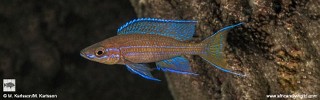
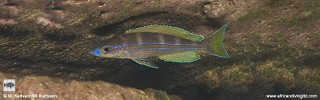
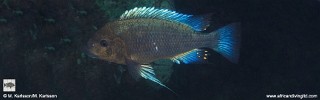
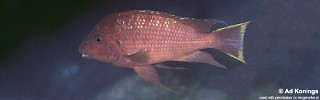
Sexual dimorphism is mainly expressed in size and coloration. Males grow substantially larger
than females and develop more intense coloration, with greyish-brown bodies and striking bright blue
fins. Females remain smaller and more uniformly colored, lacking the vivid fin coloration of dominant
males.
Recommended aquarium size:
Due to its enormous adult size and extreme territorial behavior, an aquarium of at least
1000 liters is required, although volumes of 2000 or more liters are strongly recommended for long-term
maintenance and natural behavior.
Aquarium setup:
A very large aquarium with massive rock structures, large boulders and caves, providing broad,
flat surfaces for grazing and clearly defined territories. A sandy substrate should be used, combined
with extremely powerful filtration, strong water movement and high oxygenation.
Water should be hard and alkaline (around pH 8.2), with stable temperatures between 23–26 °C.
Bright lighting is recommended to promote algal growth on rocks.
Diet:
A highly specialized herbivore feeding primarily on the algal layer covering rocks.
In aquaria, the diet should consist mainly of vegetable-based foods, especially spirulina-rich flakes
and pellets. Due to its very long intestine, high-protein foods must be offered only very sparingly to
avoid digestive disorders. Appetite is usually high, though some individuals may feed reluctantly and
lose condition.
Breeding:
Maternal mouth-brooder. Given its massive adult size, clutch sizes are large for the genus and
comprise at least 40 eggs. Spawning occurs within the male’s territory on rocky substrates. After
fertilization, the female collects the eggs into her mouth and leaves the male’s territory to brood
independently.
As in other members of the genus, and unlike Tropheus, males bear true ocelli on the anal fin, which
play an important role during spawning by attracting the female toward the genital region, thereby
maximizing fertilization efficiency.
Aggression:
Extremely aggressive and highly territorial, especially as adults. Newly imported or poorly
acclimatized individuals may appear slow-moving and tolerant, but this is misleading. Once settled,
they display the same brutal territorial behavior as other Petrochromis and are capable of exhausting
or killing tank mates. Best observed in very large tanks with numerous robust tropheines of similar
size.
Special notes:
Petrochromis sp. 'blue giant' is one of the most remarkable and controversial forms within the
genus, defined by extreme gigantism. Individuals commonly exceed 30 cm total length and may approach
40 cm, making this the largest known haplochromine cichlid from Lake Tanganyika.
The species was first encountered by African Diving Ltd. during early collection trips to Cape Mpimbwe
in 1989. An initially exported large greyish-blue Petrochromis was later recognized as a polyodon-like
form now referred to as P. sp. 'texas blue'. Subsequent collections revealed a second, even larger and
clearly distinct Petrochromis with greyish-brown body coloration and conspicuously bright blue fins in
males, which was named 'Blue Giant'.
Although once treated by Ad Konings as a distinct species, it was later synonymized with Petrochromis
polyodon. This interpretation is rejected by African Diving. P. sp. 'blue giant' is neither polyodon-like in
morphology nor part of the P. polyodon species complex and frequently occurs sympatrically with true
P. polyodon and several polyodon-like species, which excludes conspecificity.
P. sp. 'blue giant' is a specialized algal grazer restricted to habitats with large boulders and rocky
caves, and differs ecologically and morphologically from similar large Petrochromis such as
P. sp. 'texas blue neon'. Due to its immense size, extreme aggression and demanding space requirements,
it has remained rare in the aquarium hobby and is still poorly known compared to smaller members of the
genus.




Water should be hard and alkaline (around pH 8.2), with stable temperatures between 23–26 °C. Bright lighting is recommended to promote algal growth on rocks.
As in other members of the genus, and unlike Tropheus, males bear true ocelli on the anal fin, which play an important role during spawning by attracting the female toward the genital region, thereby maximizing fertilization efficiency.
The species was first encountered by African Diving Ltd. during early collection trips to Cape Mpimbwe in 1989. An initially exported large greyish-blue Petrochromis was later recognized as a polyodon-like form now referred to as P. sp. 'texas blue'. Subsequent collections revealed a second, even larger and clearly distinct Petrochromis with greyish-brown body coloration and conspicuously bright blue fins in males, which was named 'Blue Giant'.
Although once treated by Ad Konings as a distinct species, it was later synonymized with Petrochromis polyodon. This interpretation is rejected by African Diving. P. sp. 'blue giant' is neither polyodon-like in morphology nor part of the P. polyodon species complex and frequently occurs sympatrically with true P. polyodon and several polyodon-like species, which excludes conspecificity.
P. sp. 'blue giant' is a specialized algal grazer restricted to habitats with large boulders and rocky caves, and differs ecologically and morphologically from similar large Petrochromis such as P. sp. 'texas blue neon'. Due to its immense size, extreme aggression and demanding space requirements, it has remained rare in the aquarium hobby and is still poorly known compared to smaller members of the genus.
Photo gallery