Mbity Rocks, Lake Tanganyika [Now in dry land near Kasakalawe].
Biotope:
Intermediate sand–rock habitat.
Geographic distribution:
True populations are restricted to the southeastern part of the lake,
between Kasakalawe (Zambia) and Kafioko Point (Tanzania).
Ornatus-like populations are additionally recorded from central and
southern Congo, including areas around Mtoto (between Mpala and Moba),
and further south between Kiku and Moliro, as well as at Nkorosha
(Korosha) and Masanza. These Congolese populations are here regarded as
Julidochromis cf. ornatus.
Typical adult size:
Males up to 9 cm total length.
Females slightly smaller.
Sexual dimorphism:
Difficult to distinguish by coloration.
Males are typically larger than females.
Recommended aquarium size:
80 L for a bonded pair
Aquarium setup:
Fine sand substrate with extensive rockwork forming caves and crevices.
Only one pair should be kept per small aquarium due to strong intraspecific aggression.
In larger aquaria, can be combined with other small to medium Tanganyikan cichlids
occupying different zones, such as shell-dwellers or Cyprichromis species.
Diet:
Omnivorous.
Feeds on invertebrates, microfauna, algae, plankton, and sponges
collected from aufwuchs.
Breeding:
Cave spawner.
Breeds year-round, typically every 2–4 weeks.
Eggs are laid in caves or under flat rocks close to the substrate.
Clutch size around 25 very small eggs.
Parents defend the territory but do not directly care for the fry.
Older fry are tolerated until they reach about 3 cm.
Aggression:
High intraspecific aggression.
Aggression toward other species mainly during territorial defense.
Special notes:
Ornatus-like populations are also found at the northern tip of the lake
around Uvira, but most authors consider the Uvira population to be closer
to Julidochromis transcriptus than to southern J. ornatus.
The Uvira population is also smaller in adult size (approximately 7 cm
compared to up to 10 cm in southern populations) and is therefore treated
as a distinct species, Julidochromis sp. “Ornatus Uvira”.
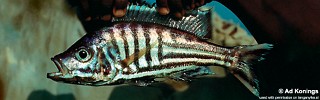
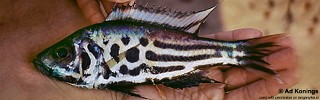

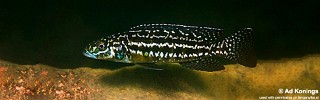



Photo gallery