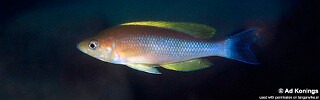
Kinyamkolo (Mpulungu) and Mbity Rocks, Lake Tanganyika, Zambia.
Biotope:
Shallow, sediment-rich habitats, often in sheltered bays and near river outlets.
Occurs at depths of approximately 1–6 m.
Water is usually less clear due to suspended sediment.
Aquatic plants such as Vallisneria spiralis, Ceratophyllum demersum and
Hydrilla verticillata are often present.
Geographic distribution:
Endemic to Lake Tanganyika.
Distributed along the shores of southern DR Congo, Zambia, Tanzania,
and southern Burundi (south of Nyanza-Lac).
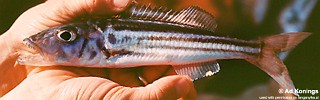
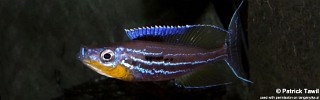
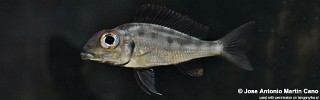
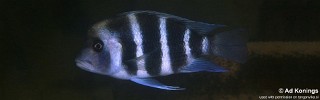
Numerous geographic color variants are known.
Typical adult size:
Males up to approximately 16 cm total length.
Females markedly smaller, usually up to about 9 cm.
Sexual dimorphism:
Strong sexual dimorphism.
Males grow significantly larger and are much more intensely colored than females.
Recommended aquarium size:
At least 300 L.
Aquarium setup:
Fine sand substrate is essential.
Provide several rocks arranged as visual barriers rather than dense rock piles.
Aquatic plants may be added to offer cover for females.
Best kept in a harem structure of one male with at least three females.
Diet:
Carnivorous.
Feeds on insect larvae, small molluscs, crustaceans and other small invertebrates
sifted from the sand.
In aquaria, accepts frozen foods such as mysis, daphnia and cyclops,
as well as high-quality prepared foods.
Breeding:
Maternal mouthbrooder.
Males construct large sand mounds (“volcano-shaped” nests),
typically 20–30 cm high and around 35 cm in diameter, often built on or against rocks.
Nests are spaced roughly 2–3 meters apart in nature.
Spawning takes place on top of the mound; eggs are collected immediately by the female
and fertilized using anal-fin egg dummies.
Typical brood size ranges from about 25 to 60 fry.
Aggression:
Extremely aggressive within the species, especially between males.
Toward other species, aggression is comparatively moderate.
Special notes:
One of the most aggressive sand-dwelling cichlids in Lake Tanganyika.
Widely distributed with many recognized geographic color variants, including
well-known forms such as ‘Ndole Bay’, ‘Moliro’, and ‘Kasanga’.
Despite its aggression, the species is highly valued for its spectacular
breeding behavior and striking coloration.



Occurs at depths of approximately 1–6 m.
Water is usually less clear due to suspended sediment.
Aquatic plants such as Vallisneria spiralis, Ceratophyllum demersum and Hydrilla verticillata are often present.
Distributed along the shores of southern DR Congo, Zambia, Tanzania, and southern Burundi (south of Nyanza-Lac).
Numerous geographic color variants are known.
Females markedly smaller, usually up to about 9 cm.
Males grow significantly larger and are much more intensely colored than females.
Provide several rocks arranged as visual barriers rather than dense rock piles.
Aquatic plants may be added to offer cover for females.
Best kept in a harem structure of one male with at least three females.
Feeds on insect larvae, small molluscs, crustaceans and other small invertebrates sifted from the sand.
In aquaria, accepts frozen foods such as mysis, daphnia and cyclops, as well as high-quality prepared foods.
Males construct large sand mounds (“volcano-shaped” nests), typically 20–30 cm high and around 35 cm in diameter, often built on or against rocks.
Nests are spaced roughly 2–3 meters apart in nature.
Spawning takes place on top of the mound; eggs are collected immediately by the female and fertilized using anal-fin egg dummies.
Typical brood size ranges from about 25 to 60 fry.
Toward other species, aggression is comparatively moderate.
Widely distributed with many recognized geographic color variants, including well-known forms such as ‘Ndole Bay’, ‘Moliro’, and ‘Kasanga’.
Despite its aggression, the species is highly valued for its spectacular breeding behavior and striking coloration.
Photo gallery