A deep-water sand and mud-dweller, occurring mainly over sandy or muddy bottoms
from about 20 m down to 100 m, and only rarely entering shallower water.
Geographic distribution
Endemic to Lake Tanganyika; recorded in suitable deep sandy and muddy habitats from
Cape Chaitika (Zambia), along the Congolese and Burundian shores to at least the
Kigoma area (Tanzania), and likely extending further south in appropriate habitat.
Typical adult size
Maximum recorded total length about 103 mm; in aquaria it typically reaches a
similar size. Tank-raised juveniles may reach about 7–8 cm within a year and
then become sexually mature.
Sexual dimorphism
Males generally grow slightly larger than females. Females are typically less
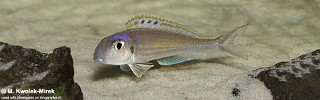
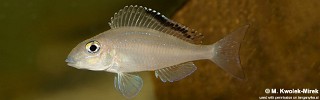
intensely coloured, appearing more silvery or grey with only faint markings
compared with males.
Recommended aquarium size
200 L
Aquarium setup
Use a fine sand substrate. Keep rockwork minimal and smooth, leaving as much open
sandy area as possible while still providing a few stones to help define territories.
In a 200 L aquarium, keep one male with several females due to strong male
intraspecific aggression; in larger aquaria (at least 150 cm length), a larger
group including multiple males can be maintained.
In sufficiently large tanks, it can be combined with smaller
Neolamprologus and Cyprichromis species.
Diet
Carnivorous. Forms small foraging groups (up to about 20 individuals) that hover
just above the substrate and take mouthfuls of sand, filtering out small
invertebrates before expelling the remaining material. Reported gut contents
include copepods as well as ostracods and insect larvae.
Breeding
Maternal mouthbrooder. Males construct and maintain territories marked by sand
turrets built from heaped sand; turrets can exceed 10 cm in height, and
different males’ territories are typically spaced widely.
Spawning may occur anywhere within the male’s territory rather than at a single
central point. Reported clutch size varies, with spawns described as around
15–20 eggs and also as about 30–40 eggs; eggs are about 3 mm long. The male
fertilizes the eggs, which the female then takes into her mouth and incubates for
about three weeks before releasing the fry. No post-release brood care has been
reported.
Aggression
Males can be strongly territorial and aggressive toward conspecific males. Best
kept as one male with several females in smaller aquaria; multiple males require a
larger tank (at least 150 cm length) with adequate space to reduce conflict.
Special notes
A deep-water Xenotilapia associated with sandy and muddy habitats.
Diagnostic notes indicate that Xenotilapia bathyphilus can be separated
from most congeners by a combination of fin-ray counts and body proportions, and
from X. ochrogenys by caudal-peduncle proportions and coloration.
It is morphologically similar to the potentially undescribed
Xenotilapia sp. ‘bathyphilus yellow’. The two can be distinguished by the
colour of the lips: X. bathyphilus has blue lips, while
X. sp. ‘bathyphilus yellow’ has yellow lips.



In a 200 L aquarium, keep one male with several females due to strong male intraspecific aggression; in larger aquaria (at least 150 cm length), a larger group including multiple males can be maintained.
In sufficiently large tanks, it can be combined with smaller Neolamprologus and Cyprichromis species.
Spawning may occur anywhere within the male’s territory rather than at a single central point. Reported clutch size varies, with spawns described as around 15–20 eggs and also as about 30–40 eggs; eggs are about 3 mm long. The male fertilizes the eggs, which the female then takes into her mouth and incubates for about three weeks before releasing the fry. No post-release brood care has been reported.
Diagnostic notes indicate that Xenotilapia bathyphilus can be separated from most congeners by a combination of fin-ray counts and body proportions, and from X. ochrogenys by caudal-peduncle proportions and coloration.
It is morphologically similar to the potentially undescribed Xenotilapia sp. ‘bathyphilus yellow’. The two can be distinguished by the colour of the lips: X. bathyphilus has blue lips, while X. sp. ‘bathyphilus yellow’ has yellow lips.
Photo gallery