Shallow rocky habitat. Found in shallow waters down to about 5–6 m, with the highest concentrations
typically at depths of 2–3 m.
Geographic distribution:
Occurs along rocky shores around the entire Lake Tanganyika, showing considerable geographical
variation.
Typical adult size:
Males usually reach around 15 cm total length; females remain about 20% smaller. In aquaria,
individuals may grow slightly larger.
Sexual dimorphism:
Females are generally smaller than males by roughly 20%.
Recommended aquarium size:
Because it is smaller and somewhat less aggressive than most Petrochromis, an aquarium of
approximately 400–500 L is sufficient.
Aquarium setup:
Provide abundant rockwork arranged into separated rock piles to create distinct territories, while
still leaving ample open swimming space between them.
Use sand as the substrate and ensure very strong filtration, as Petrochromis consume large quantities of food
and consequently produce significant waste.
Diet:
Herbivorous grazer with a strong appetite. In nature it feeds mainly on algae scraped from rocks;
in aquaria it should be offered a diet rich in vegetable matter, especially spirulina-based flakes or pellets.
High-protein foods should be given only sparingly.
Breeding:
Maternal mouthbrooder.
The male lures the female into his territory, where she lays eggs and immediately collects them in her mouth.
She then attempts to pick up the male’s egg spots, during which sperm is released and taken into the mouth,
resulting in fertilization inside the female’s mouth.
Broods usually consist of around 15 eggs in nature and often around 30 in aquaria. After roughly 30 days the
female releases well-developed fry. Notably, the female continues feeding during brooding, which is uncommon
among many other mouthbrooders.
Aggression:
Highly aggressive toward conspecifics (both males and females), though slightly less so than many
other Petrochromis. Keeping them in larger groups helps distribute aggression and reduces excessive pressure on
females.
Toward other species they are generally less aggressive, although males will defend their territories.
Special notes:
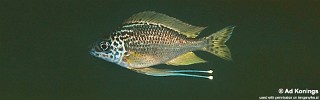
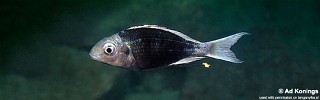
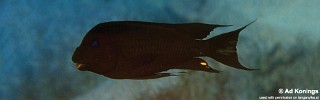
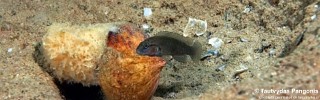
One of the smaller members of the genus, occupying shallow rocky habitats across the lake. It often
shares habitat with larger species such as Petrochromis polyodon and Petrochromis ephippium, securing
territories mainly in narrow crevices and caves inaccessible to larger congeners.
Non-territorial males and females may form large groups, which allows them to access feeding areas defended by
larger Petrochromis.
Compared to other Petrochromis, it is slightly less aggressive and similar in size to Tropheus, making it
suitable for mixed aquaria with them. Unlike Tropheus, Petrochromis famula is not a fin nipper.





Use sand as the substrate and ensure very strong filtration, as Petrochromis consume large quantities of food and consequently produce significant waste.
The male lures the female into his territory, where she lays eggs and immediately collects them in her mouth. She then attempts to pick up the male’s egg spots, during which sperm is released and taken into the mouth, resulting in fertilization inside the female’s mouth.
Broods usually consist of around 15 eggs in nature and often around 30 in aquaria. After roughly 30 days the female releases well-developed fry. Notably, the female continues feeding during brooding, which is uncommon among many other mouthbrooders.
Toward other species they are generally less aggressive, although males will defend their territories.
Non-territorial males and females may form large groups, which allows them to access feeding areas defended by larger Petrochromis.
Compared to other Petrochromis, it is slightly less aggressive and similar in size to Tropheus, making it suitable for mixed aquaria with them. Unlike Tropheus, Petrochromis famula is not a fin nipper.
Photo gallery