Upper part of the water column in relatively shallow water, most often within the top
10 meters. Most frequently encountered over intermediate habitats with mainly sandy bottom and
scattered stones, though it also occurs in rocky environments.
Geographic distribution:
Recorded from many sites around Lake Tanganyika, indicating a lake-wide distribution.
Typical adult size:
Up to about 7 cm total length; females are only a few millimeters smaller than males.
Sexual dimorphism:
No visible sexual dimorphism; females share the same coloration and are less than 5%
smaller than males.
Recommended aquarium size:
At least 200 L.
Aquarium setup:
Provide fine sand with a few scattered stones and ample open swimming space. Keep in a
sizeable group, as the species naturally forms very large schools.
Diet:
Carnivorous zooplanktivore. Feeds on zooplankton, selecting individual organisms with a
protrusible mouth; stomach examinations have found exclusively copepods in examined individuals from
a Zambian population.
Breeding:
Biparental mouthbrooder with very small eggs (about 2.0 mm). Brood size is low: reports
range from about 6 to 15 eggs/fry, with wild females averaging around 8–9 eggs. The female initially
holds the eggs; when fry reach about 5 mm (around one week), she transfers roughly half of the brood
to the male. Both parents may brood simultaneously while remaining within the foraging school and
feeding normally. Incubation lasts about three weeks; by the end each parent typically carries only a
few fry (on average about two) of roughly 15 mm. Released juveniles may join schools of similar-sized
fishes or be released near guarded fry schools of other species; fry have been observed mixed with
Perissodus microlepis fry and, when somewhat older, with Lepidiolamprologus elongatus fry, whose
parents tolerated the presence of foreign young.
Aggression:
Peaceful toward conspecifics and other species.
Special notes:
Distinguished from Microdontochromis tenuidentatus by having two or three (rarely one)
tooth rows in both jaws, a rounded distal margin of the pelvic fin, a proportionally longer outermost
pelvic-fin soft ray, a deeper body, and usually 9 anal-fin soft rays (versus usually 10). In
underwater observations, adults are often recognizable because M. tenuidentatus usually shows vertical
flank bars while M. rotundiventralis does not. This species was historically placed among Xenotilapia,
but later DNA-based work led to its placement in the genus Microdontochromis; it also differs from
Xenotilapia in spending substantial time feeding in open water rather than only near the bottom.
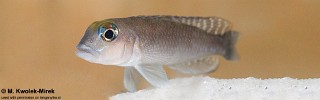
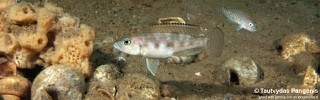
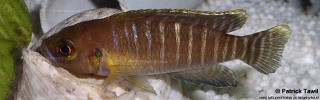
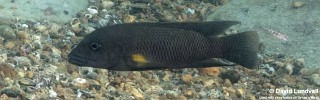



Photo gallery