Sumbu National Park region, Lake Tanganyika, Zambia
Biotope:
Sediment-rich rocky habitat
Geographic distribution:
Endemic to Lake Tanganyika.
Southwestern part of the lake, traditionally reported between
Cape Kachese (Zambia) and the Lunangwa River (DR Congo).
Julidochromis dickfeldi-like forms reported further north,
referred to as J. cf. dickfeldi and
J. sp. “Dickfeldi Congo” (“Midnight Blue”).
Typical adult size:
Males up to 10 cm.
Females smaller, up to 7 cm.
Sexual dimorphism:
Difficult to distinguish by coloration.
Males are typically larger than females.
Recommended aquarium size:
80 L for a pair
Aquarium setup:
Rock-dominated aquarium with many stones arranged
to form caves and hiding places.
Provide multiple shelters to reduce aggression.
Best kept as a single established pair.
Diet:
Omnivorous.
In nature feeds mainly on invertebrates and small snails.
In aquarium accepts Cyclops, Daphnia, Mysis and similar foods.
Breeding:
Cave spawner.
Spawning takes place inside caves, away from other fish.
Clutch size usually 35–50 eggs.
Biparental care of eggs and fry until the next spawning cycle.
Spawning interval approximately every 4–5 weeks.
Aggression:
Highly aggressive towards conspecifics and other species,
especially when defending territory.
Not recommended to keep with other Julidochromis species.
Special notes:
Characterized by a pointed snout, blue sheen over the body
and blue edging on dorsal and caudal fins.
Three horizontal stripes are more intense than in
Julidochromis ornatus.
Considered morphologically intermediate between
Chalinochromis popelini and other Julidochromis species,
resembling C. popelini in habitat preference and feeding behavior.
Taxonomic status has been questioned by several authors.
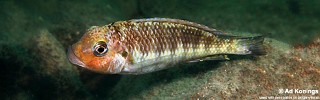
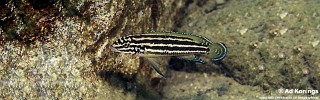
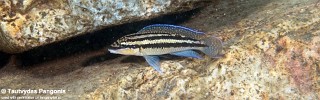
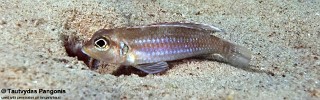
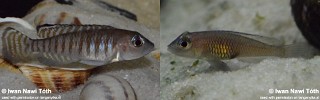



Photo gallery