Lunangwa Bay, Lake Tanganyika, Democratic Republic of Congo
Biotope:
Rocky habitats, most commonly encountered between 7 and 15 m depth,
but occurring from approximately 4 to 20 m.
Geographic distribution:
Central western Congolese coast of Lake Tanganyika, occurring between
Mtoto and Cape Tembwe, possibly extending slightly further north.
Typical adult size:
Approximately 9–10 cm total length.
Sexual dimorphism:
No marked sexual dimorphism; males are on average slightly larger than
females.
Recommended aquarium size:
200 L for a pair or small colony; larger aquaria (300 L or more) are
required for larger colonies.
Aquarium setup:
Fine sand substrate combined with rock structures forming caves and
passages. Due to rapid colony expansion and effective territorial defence,
this species is best kept in a species-only aquarium.
Diet:
Carnivorous; feeds mainly on small invertebrates such as insect larvae
and copepods, collected from the bioperiphyton or water column above the
substrate.
Breeding:
Once a pair is established, spawning occurs regularly. Each pair
occupies a territory defended not only by the breeders but also by numerous
helpers, sometimes exceeding 20 individuals. Initially small clutches are
produced, later increasing to up to 150 eggs. Fry of different ages form
structured colonies, with older juveniles assisting in territorial defence.
Females may deposit eggs not only inside caves but also on exposed rock
surfaces or aquarium glass.
Aggression:
Highly aggressive towards other species and capable of repelling much
larger fishes through coordinated colony defence. Territorial expansion
increases as the colony grows.
Special notes:
As with several species described in Pierre Brichard’s last book
(Brichard, 1989), Neolamprologus olivaceous is considered an
ill-described taxon. The original description contains inconsistencies,
including a spelling error in the species name that nevertheless became
valid due to page priority. Its distinction from Neolamprologus pulcher,
which shares the same two chevron-shaped facial markings behind the eye,
remains disputed.
Facial patterns alone appear insufficient for reliable species separation
within the brichardi–pulcher complex, as even the characteristic T-shaped
marking of N. brichardi has arisen independently in multiple areas of
the lake. For this reason, some authors advocate merging several taxa,
including N. brichardi and N. pulcher, into a single species,
which would also place N. olivaceous into synonymy.
Nevertheless, the pronounced geographical variation observed within this
complex has produced locally distinctive forms, among which
N. olivaceous represents a particularly recognizable variant. Even if
future revisions confirm synonymy with N. pulcher, the practical need
for names to describe such geographically and morphologically distinct forms
will likely persist, whether at species or subspecies level.
For these reasons, and because synonymy has not been unequivocally
demonstrated, this taxon is here retained as a valid species. Both Ad
Konings and the Karlsson brothers have expressed doubts regarding its status,
citing in particular the incomplete original description by Brichard and the
risk that premature synonymization may obscure real biological diversity
within the group.
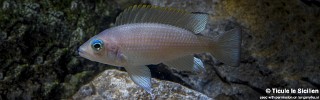
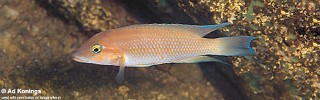
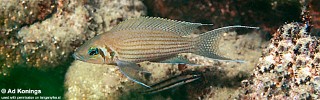
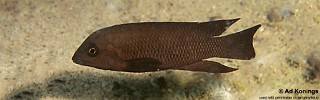
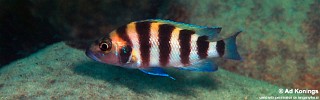



Facial patterns alone appear insufficient for reliable species separation within the brichardi–pulcher complex, as even the characteristic T-shaped marking of N. brichardi has arisen independently in multiple areas of the lake. For this reason, some authors advocate merging several taxa, including N. brichardi and N. pulcher, into a single species, which would also place N. olivaceous into synonymy.
Nevertheless, the pronounced geographical variation observed within this complex has produced locally distinctive forms, among which N. olivaceous represents a particularly recognizable variant. Even if future revisions confirm synonymy with N. pulcher, the practical need for names to describe such geographically and morphologically distinct forms will likely persist, whether at species or subspecies level.
For these reasons, and because synonymy has not been unequivocally demonstrated, this taxon is here retained as a valid species. Both Ad Konings and the Karlsson brothers have expressed doubts regarding its status, citing in particular the incomplete original description by Brichard and the risk that premature synonymization may obscure real biological diversity within the group.
Photo gallery