Sandy and muddy habitats. Occurs from shallow water down to at least 75 m depth
(possibly deeper).
Geographic distribution:
Endemic to Lake Tanganyika, with a lake-wide distribution in suitable habitats.
Geographical variation is limited; males from the northern part of the lake tend
to show more blackish body spots than southern populations.
Typical adult size:
Males up to about 27 cm, females usually up to around 22 cm.
Sexual dimorphism:
Weak. Males generally grow larger than females. Sexually active males may develop
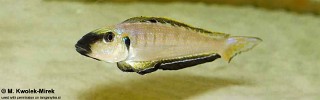
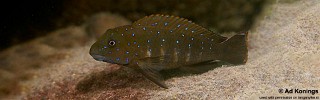
a faint bluish hue and, depending on population, several blackish body spots.
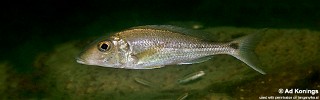
Females remain silvery; ripe females show a rounded belly.
Recommended aquarium size:
Minimum 400 L.
Aquarium setup:
A sandy substrate is essential. Provide a large open swimming area with minimal
decoration. This is a generally peaceful species and should not be kept with
aggressive cichlids. Best maintained as a pair or in small groups.
Diet:
Carnivorous. Feeds on a wide range of invertebrates and molluscs. In nature it
filters sand and mud, ingesting edible particles and expelling substrate through
the mouth and gills. Known to consume algae, copepods, ostracods, insect larvae,
shrimps, clams and small fish.
Breeding:
Maternal mouthbrooder. Males defend temporary territories but do not construct
sand-scrape nests. Displaying males isolate ripe females from the school and
spawn directly. Females incubate eggs and larvae for about four weeks; clutch
size is around 50 fry.
Aggression:
Moderately aggressive.
Special notes:
Grammatotria lemairii is by far the largest sand-sifting cichlid in Lake
Tanganyika. Although it shares some similarities with species of the genus
Xenotilapia, it is easily distinguished by its large size and the distinct
black spot on the caudal peduncle.
Outside the breeding season, this species forms large foraging schools. Its ability
to penetrate deeply into the substrate with its pointed snout allows it to access
food unavailable to smaller sand-sifters. Despite its impressive size, it remains
an underrated species in the hobby due to its subdued coloration.
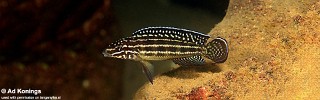



Outside the breeding season, this species forms large foraging schools. Its ability to penetrate deeply into the substrate with its pointed snout allows it to access food unavailable to smaller sand-sifters. Despite its impressive size, it remains an underrated species in the hobby due to its subdued coloration.
Photo gallery