Deep-water habitats over muddy substrate. Recorded from a wide depth range of
approximately 5 to 125 m, with most observations around deeper zones where light intensity is low.
Geographic distribution:
Lake-wide distribution in suitable habitats throughout Lake Tanganyika.
Typical adult size:
Up to about 19 cm total length in males, with females reaching around 16 cm; most
individuals are usually smaller, and specimens over 14 cm are considered uncommon.
Sexual dimorphism:
Weakly expressed. Males tend to grow slightly larger than females, which is typical
for biparental mouthbrooders.
Recommended aquarium size:
At least 300 L.
Aquarium setup:
Because this species naturally inhabits deep water with reduced light levels, subdued
lighting is recommended in the aquarium. Provide a soft substrate with plenty of fine sand, along
with caves and tunnels formed from rocks or pipes. It should be kept together with other calm
Lake Tanganyika cichlids and not with highly aggressive or territorial species.
Diet:
Carnivorous. In the lake it feeds mainly on invertebrates and small snails, which are
crushed using molariform pharyngeal teeth. In the aquarium it accepts a variety of live and frozen
foods.
Breeding:
Biparental mouthbrooder. Spawning takes place in a dug tunnel or cave. The male enters
the tunnel to release milt and leaves; the female then enters alone to deposit eggs, which are
immediately collected into her mouth. This sequence is repeated until spawning is completed.
Fertilization occurs in the water containing the male’s seminal fluids. Both parents share the
mouthbrooding duties, exchanging eggs and larvae for about two weeks. Clutch size is usually large,
often around 300 eggs, with a minimum of about 100 reported.
Aggression:
Moderately aggressive.
Special notes:
Characterized by a rounded head profile combined with a distinctly protruding small
snout and upper lip, which represents a diagnostic feature within the Limnochromini. It is a
calm and mild-mannered species and is well suited for aquarists interested in keeping a
biparental mouthbrooding Tanganyikan cichlid.
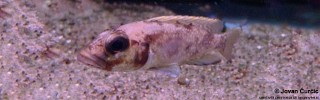
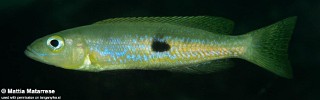
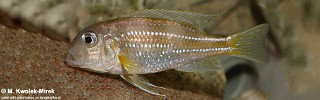
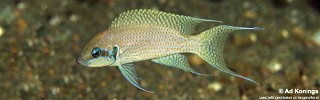



Photo gallery