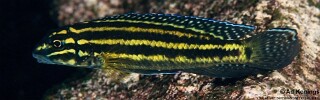
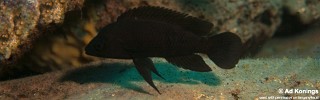
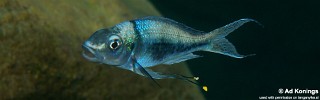
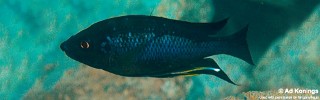
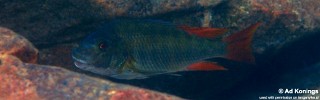
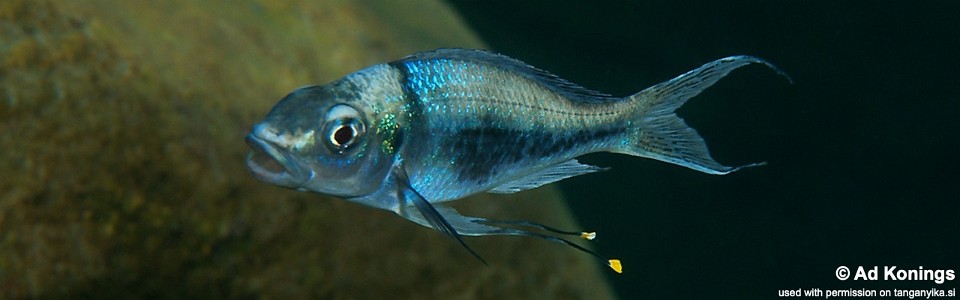
Mboko Island, Lake Tanganyika, Democratic Republic of Congo
Biotope:
Inhabits the upper part of the rocky habitat and is most abundant at depths of about 3–5 m.
As with other members of the genus, it occurs from surge zones to intermediate habitats, with type specimens
collected over rock, gravel or shingles, and it may also occur in purely rocky littoral areas.
Geographic distribution:
Endemic to Lake Tanganyika and restricted to the north-western part of the lake.
It is reported from Kalemie northwards to the extreme north of the lake; no geographic variants are known.
Typical adult size:
Males reach around 15 cm total length, with females remaining about 2–3 cm smaller
(commonly around 12 cm).
A maximum size of 144 mm total length for males and 118 mm for females has also been reported.
Sexual dimorphism:
Only males develop strong coloration, while females remain silvery/greyish and are difficult to
distinguish from females of other members of the Ophthalmotilapia ventralis superspecies.
Males have longer fins than females, particularly the pelvic fins.
Recommended aquarium size:
400 L when keeping multiple males.
In simpler setups with fewer males, a slightly smaller aquarium of around 300 L may be sufficient.
Aquarium setup:
Ophthalmotilapia heterodonta is sensitive to disturbance and transport and can be difficult
to acclimatize, but becomes less fussy once established under suitable conditions.
It should not be housed with aggressive cichlids; tank mates are best chosen among smaller Lake Tanganyika
species such as shell-dwelling lamprologines, cyprichromines or eretmodines, and other half-grown ectodines may
help it settle if they remain smaller in medium-sized aquaria.
Because of the likelihood of hybridization, it should not be kept with other species of Ophthalmotilapia,
including members of the O. ventralis superspecies; O. boops and O. sp. ‘paranasuta’
are specifically noted to be unsuitable together with it.
A spacious aquarium is recommended, especially when housing several males; males are very aggressive toward one
another, and keeping at least three males is often advised to spread aggression and encourage natural territorial
behaviour.
Fine sand is important because males construct crater-like bowers or volcano-shaped nests, often over or near a
large flat rock, and rockwork should be provided to create structure and refuges.
Water should be hard, alkaline and clean, with good oxygenation; temperature has been reported around 24–27 °C,
with pH reported from 7.8 to 9.5.
Diet:
Reported dietary information differs between sources.
It is described as primarily vegetarian, feeding mainly on aufwuchs and algae while also ingesting associated
microorganisms, and females and non-territorial males also take plankton when available.
Other reports describe a mainly insectivorous diet, with stomach contents including sand, filamentous algae,
small crustaceans (ostracods), insect larvae and adult insects that fall into the water, and note that it differs
from more vegetarian relatives such as Ophthalmotilapia nasuta.
Breeding:
Maternal mouthbrooder, breeding in a manner similar to other Ophthalmotilapia.
Males establish leks and build a sand crater or volcano-shaped bower (reported as about 10–12 cm in diameter)
over a flat rock that serves as the spawning site, and display to approaching females with quivering swimming.
The female is attracted by the yellow lappets at the end of the pelvic fins rather than anal-fin ocelli; she may
sometimes remain alone in the nest while the male drives off intruders, and may even lay eggs alone before the
male returns and quivers against the substrate.
After spawning the female mouthbroods alone and leaves the male’s territory; reported clutch sizes include
about 10–16 eggs, and a field record describes a female holding eight large eggs about 3.5 mm in diameter.
A breeding season between March and September has been reported.
Aggression:
Can be quite aggressive, especially between males.
Dominant males vigorously defend their territories and nesting sites, and aggression increases around spawning
and while protecting offspring; a larger aquarium is recommended when keeping multiple males.
Special notes:
Male coloration is used as a key distinguishing feature within the O. ventralis superspecies,
with males described as showing a black spindle-like marking on the flank over a light, shining sky-blue ground
color; females across the complex are very similar and cannot be separated reliably. Ophthalmotilapia heterodonta differs from O. boops by coloration and dentition, as O. boops
has tricuspid teeth in the outer rows, whereas other members of the genus are described as bicuspid.
The name O. heterodonta was long misapplied in the aquarium hobby, and fish illustrated as
O. heterodonta in earlier literature were later recognized as an undescribed species,
O. sp. ‘paranasuta’, a confusion emphasized in discussions by P. Tawil (2014).
The true O. heterodonta is restricted to the western Congolese coast, and the population from Mboko Island
is the basis for the description; field observations have been cited as supporting that O. sp. ‘paranasuta’
is absent from that coast.



As with other members of the genus, it occurs from surge zones to intermediate habitats, with type specimens collected over rock, gravel or shingles, and it may also occur in purely rocky littoral areas.
It is reported from Kalemie northwards to the extreme north of the lake; no geographic variants are known.
A maximum size of 144 mm total length for males and 118 mm for females has also been reported.
Males have longer fins than females, particularly the pelvic fins.
In simpler setups with fewer males, a slightly smaller aquarium of around 300 L may be sufficient.
It should not be housed with aggressive cichlids; tank mates are best chosen among smaller Lake Tanganyika species such as shell-dwelling lamprologines, cyprichromines or eretmodines, and other half-grown ectodines may help it settle if they remain smaller in medium-sized aquaria.
Because of the likelihood of hybridization, it should not be kept with other species of Ophthalmotilapia, including members of the O. ventralis superspecies; O. boops and O. sp. ‘paranasuta’ are specifically noted to be unsuitable together with it.
A spacious aquarium is recommended, especially when housing several males; males are very aggressive toward one another, and keeping at least three males is often advised to spread aggression and encourage natural territorial behaviour.
Fine sand is important because males construct crater-like bowers or volcano-shaped nests, often over or near a large flat rock, and rockwork should be provided to create structure and refuges.
Water should be hard, alkaline and clean, with good oxygenation; temperature has been reported around 24–27 °C, with pH reported from 7.8 to 9.5.
It is described as primarily vegetarian, feeding mainly on aufwuchs and algae while also ingesting associated microorganisms, and females and non-territorial males also take plankton when available.
Other reports describe a mainly insectivorous diet, with stomach contents including sand, filamentous algae, small crustaceans (ostracods), insect larvae and adult insects that fall into the water, and note that it differs from more vegetarian relatives such as Ophthalmotilapia nasuta.
Males establish leks and build a sand crater or volcano-shaped bower (reported as about 10–12 cm in diameter) over a flat rock that serves as the spawning site, and display to approaching females with quivering swimming.
The female is attracted by the yellow lappets at the end of the pelvic fins rather than anal-fin ocelli; she may sometimes remain alone in the nest while the male drives off intruders, and may even lay eggs alone before the male returns and quivers against the substrate.
After spawning the female mouthbroods alone and leaves the male’s territory; reported clutch sizes include about 10–16 eggs, and a field record describes a female holding eight large eggs about 3.5 mm in diameter.
A breeding season between March and September has been reported.
Dominant males vigorously defend their territories and nesting sites, and aggression increases around spawning and while protecting offspring; a larger aquarium is recommended when keeping multiple males.
Ophthalmotilapia heterodonta differs from O. boops by coloration and dentition, as O. boops has tricuspid teeth in the outer rows, whereas other members of the genus are described as bicuspid.
The name O. heterodonta was long misapplied in the aquarium hobby, and fish illustrated as O. heterodonta in earlier literature were later recognized as an undescribed species, O. sp. ‘paranasuta’, a confusion emphasized in discussions by P. Tawil (2014).
The true O. heterodonta is restricted to the western Congolese coast, and the population from Mboko Island is the basis for the description; field observations have been cited as supporting that O. sp. ‘paranasuta’ is absent from that coast.
Photo gallery