Open water above sandy bottoms, often in relatively shallow areas.
Occurs in warm, hard and alkaline water.
Geographic distribution:
Endemic to Lake Tanganyika.
Distributed lake-wide; no known geographic variants.
Recommended aquarium size:
Aquarium length of at least 120 cm.
Aquarium setup:
Fine sand substrate is essential.
Small, rounded stones may be added to help define male territories.
Best kept in small groups with a surplus of females.
Suitable tankmates include sand-oriented species such as Xenotilapia.
Diet:
Feeds by scooping sand, filtering edible material, and expelling the sand through mouth and gills.
Natural diet includes algae, micro-organisms, and organic matter within the sand.
Forms large foraging schools.
Breeding:
Maternal mouthbrooder.
Males construct small sand-scrape nests and attempt to lure passing females.
Incubation period lasts approximately 18–21 days.
Special notes:
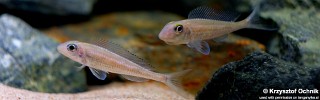
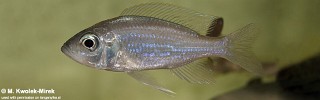
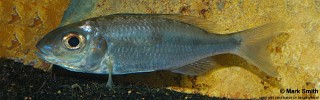
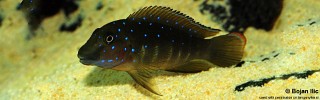
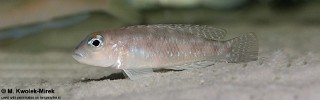
Can be confused with Ectodus descampsii, but differs by a more rounded head profile.
The diagnostic black spot is located at the base of the dorsal fin, whereas in E. descampsii
it is positioned in the middle of the dorsal fin.



Occurs in warm, hard and alkaline water.
Distributed lake-wide; no known geographic variants.
Small, rounded stones may be added to help define male territories.
Best kept in small groups with a surplus of females.
Suitable tankmates include sand-oriented species such as Xenotilapia.
Natural diet includes algae, micro-organisms, and organic matter within the sand.
Forms large foraging schools.
Males construct small sand-scrape nests and attempt to lure passing females.
Incubation period lasts approximately 18–21 days.
The diagnostic black spot is located at the base of the dorsal fin, whereas in E. descampsii it is positioned in the middle of the dorsal fin.
Photo gallery