Kapampa and Kileba Bay, Lake Tanganyika, Democratic Republic of Congo
Biotope:
Primarily inhabits the intermediate habitat, where it is displaced by larger and more specialized
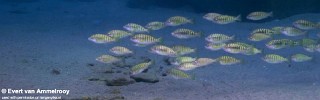
Petrochromis. When food is abundant, it may form large shoals and temporarily invade rocky habitats dominated
by other Petrochromis.
Geographic distribution:
Found around the entire shoreline of Lake Tanganyika in suitable habitats. Several geographical
variants are known; the most familiar in aquaristics originates from central Tanzania.
Typical adult size:
Males reach around 15 cm total length; females remain about 20% smaller. In aquaria, individuals may
grow slightly larger.
Sexual dimorphism:
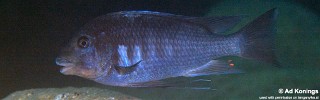
Both sexes generally share similar overall coloration. In some geographical forms, males may show
distinctive features such as a red upper eye or orange to blue coloration in the dorsal fin. Territorial males
are typically more intensely colored, with blurred vertical bars.
Recommended aquarium size:
Although a smaller Petrochromis, its strong intraspecific aggression requires an aquarium of at
least 500 L.
Aquarium setup:
Provide abundant rockwork arranged into separated rock piles to create distinct territories, while
still allowing ample open swimming space between them.
Use sand as the substrate and ensure very strong filtration due to the large amount of food consumed and the
resulting waste production.
Diet:
Herbivorous grazer with a strong appetite. In nature it feeds mainly on algae scraped from rocks; in
aquaria it should be provided with a diet rich in vegetable matter, especially spirulina-based flakes or
pellets.
Breeding:
Maternal mouthbrooder.
The male attracts the female into his territory, where spawning takes place. Eggs are collected into the
female’s mouth, and fertilization occurs inside the mouth during interaction with the male’s egg spots.
Broods are relatively small, usually around 15 eggs in nature and often around 30 in aquaria. After roughly
30 days the female releases well-developed fry and is known to continue feeding during the brooding period.
Aggression:
Highly aggressive toward conspecifics, though generally less extreme than in larger Petrochromis.
Housing them in larger groups helps distribute aggression and reduces fatal outcomes.
Toward other species they are less aggressive, but males will defend their territories.
Special notes:
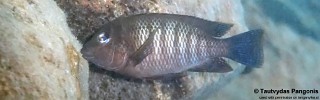
One of the smaller Petrochromis, notable for its slightly upturned mouth, a feature that
distinguishes it from other members of the genus whose mouths are terminal or slightly downturned.
It commonly forms large shoals in intermediate habitats, allowing access to feeding areas otherwise dominated
by larger Petrochromis through numerical advantage.
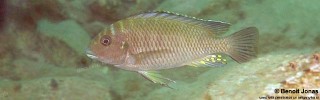
Several geographical races exist. The well-known “Red Eye” form from central Tanzania shows bright orange-red
eyes, while other populations display variations ranging from cream white to darker gray, often with colored
fins. These forms are considered geographical variants rather than distinct species.




Use sand as the substrate and ensure very strong filtration due to the large amount of food consumed and the resulting waste production.
The male attracts the female into his territory, where spawning takes place. Eggs are collected into the female’s mouth, and fertilization occurs inside the mouth during interaction with the male’s egg spots.
Broods are relatively small, usually around 15 eggs in nature and often around 30 in aquaria. After roughly 30 days the female releases well-developed fry and is known to continue feeding during the brooding period.
Toward other species they are less aggressive, but males will defend their territories.
It commonly forms large shoals in intermediate habitats, allowing access to feeding areas otherwise dominated by larger Petrochromis through numerical advantage.
Several geographical races exist. The well-known “Red Eye” form from central Tanzania shows bright orange-red eyes, while other populations display variations ranging from cream white to darker gray, often with colored fins. These forms are considered geographical variants rather than distinct species.
Photo gallery