Rocky and intermediate habitats, most commonly at depths of 5–15 m.
Geographic distribution:
Lake Tanganyika (Tanzania), from Magambo to Miyako Point.
Typical adult size:
Up to 13 cm total length in the lake; in aquaria can reach up to 16 cm.
Sexual dimorphism:
Males are always larger than females.
Recommended aquarium size:
150 L (pair).
Aquarium setup:
Provide extensive rockwork with many passages and hiding places.
Due to strong intraspecific aggression, keep as a pair in smaller tanks,
while groups require a much larger aquarium (about 500 L or more).
A practical approach is to start with a group of juveniles and remove
extra individuals once a stable pair forms.
Diet:
Feeds on sponges and invertebrates picked from aufwuchs on rocks, and may also take
other small invertebrates and some algae.
In aquaria it accepts most foods; offer quality frozen/live options such as krill and mysis.
Breeding:
Pair-forming cave spawner. Spawning occurs inside caves; parents defend large broods
(reported over 150 juveniles). When fry reach about 1 cm, the parents move them out of the cave
into the open. Early fry behave “Julidochromis-like” (staying close to rocks), later forming a
loose “cloud” typical of larger lamprologines. Parents guard the brood for a period and then leave it.
Aggression:
Highly aggressive toward conspecifics; also becomes aggressive toward other species during breeding.
Special notes:
Treated on tanganyika.si as a separate species, Chalinochromis sp. 'ndobhoi'.
Juveniles show two horizontal body lines which, in adults, become broken/dashed; typical
C. brichardi forms are plain without such body striping.
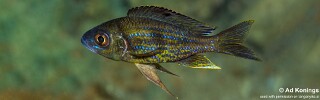
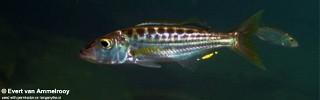




Photo gallery