Sandy habitat down to a maximum depth of about 50 m, but rarely found
deeper than 20 m. Often occurs in sheltered bays and may seek refuge
among aquatic vegetation (Potamogeton).
Geographic distribution:
Endemic to Lake Tanganyika with a northern distribution, occurring between
Kalubamba (Democratic Republic of Congo) and Sibwesa (Tanzania).
Some population-based variation is present.
Typical adult size:
Males reach up to about 12 cm total length, while females remain
slightly smaller. Juveniles grow to 7–8 cm within one year and
reach sexual maturity at that size.
Sexual dimorphism:
Strong sexual dimorphism and dichromatism. Sexually active males are larger
and display intense coloration, whereas females are silvery with only
vague markings.
Recommended aquarium size:
Around 300 liters, with a minimum aquarium length of 130–150 cm
for a long-term maintenance of an adult group.
Aquarium setup:
An open aquarium layout with extensive areas of fine sand and no need for
rocks. Tank mates must be chosen carefully and should not include
aggressive, territorial, or bottom-dwelling species occupying the same
niche. Best kept in groups of at least eight individuals, including
several males. Excellent water quality is essential.
Diet:
Carnivorous. Feeds mainly on chironomid larvae, aquatic worms, ostracods
and copepods. Forages by sliding close to the substrate while sifting sand
for food, expelling non-edible material through the mouth and gills.
Outside the breeding season, it forms foraging groups of up to
about 30 individuals.
Breeding:
Maternal mouthbrooder. Males construct sand-scrape spawning sites consisting
of small sand heaps arranged in a circle around a shallow central
depression, used to attract females. Females incubate eggs and larvae for
approximately three weeks before releasing the fry. Maximum brood size is
around 40. Breeding occurs year-round, with a peak during the rainy season
from December to May.
Aggression:
Generally peaceful. Males may show mild intraspecific aggression, which is
best managed by keeping the species in sufficiently large groups.
Special notes:
Closely related to Xenotilapia singularis, from which it differs
mainly in male coloration and head profile. Males of
X. ochrogenys lack the 3–5 large black flank blotches that are
characteristic of X. singularis.
Once believed to be distributed throughout the entire lake, it is now
known to inhabit only the northern part, while
X. singularis occupies the southern regions. The two species are
sympatric around Kalya (Tanzania) and between Moba and Kalubamba
(D.R. Congo).
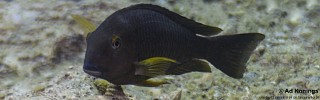
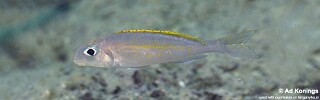
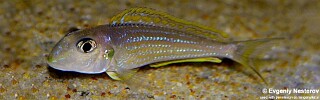
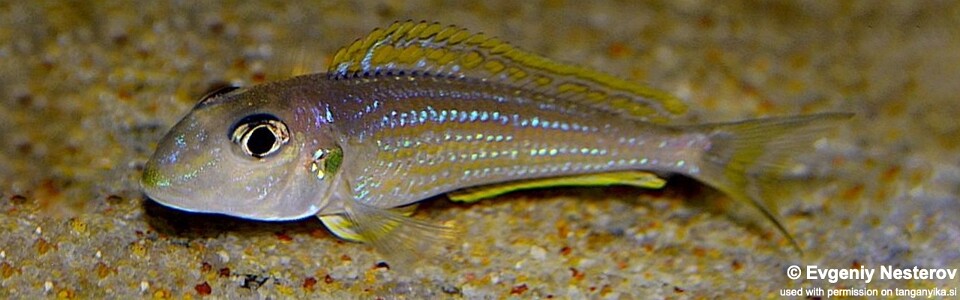



Once believed to be distributed throughout the entire lake, it is now known to inhabit only the northern part, while X. singularis occupies the southern regions. The two species are sympatric around Kalya (Tanzania) and between Moba and Kalubamba (D.R. Congo).
Photo gallery