Open water along deep rocky shores at depths of approximately
5–30 m. Occurs in very large schools, often numbering hundreds
or even thousands of individuals. Frequently observed together
with Cyprichromis leptosoma, C. sp. 'leptosoma jumbo',
Paracyprichromis nigripinnis and P. brieni.
Geographic distribution:
Endemic to Lake Tanganyika. Occurs in the northern half of the lake.
On the western shore (DR Congo) found north of Kalemie and further
north along the coast. On the eastern shore found northwards from
Sibwesa in Tanzania. The overall distribution extends between the
Kavala Islands (western shore) and Bulu Point (eastern shore).
Typical adult size:
Males reach up to approximately 12 cm total length.
Females are typically 1–2 cm smaller.
Sexual dimorphism:
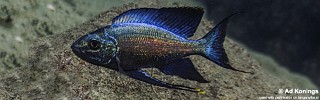
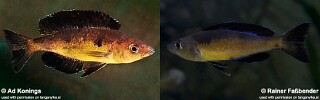
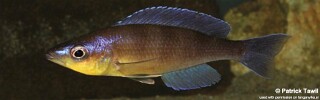
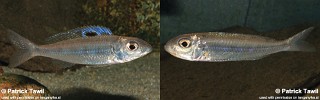
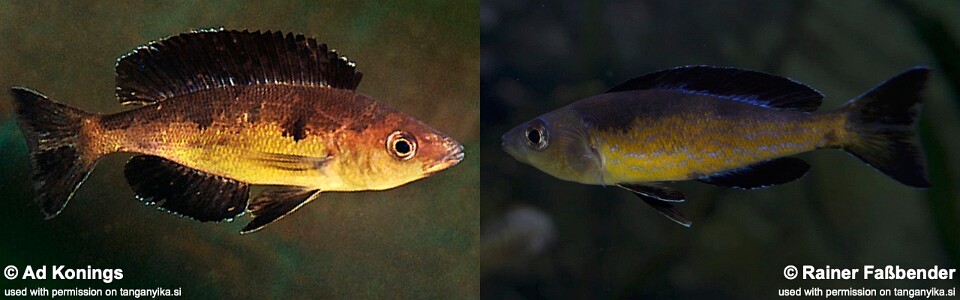
Males are larger and much more colourful than females.
Males exhibit pronounced polychromatism, with considerable colour
variation even within the same population. Females are beige to
light brown.
Recommended aquarium size:
Minimum 350 L
Aquarium setup:
Provide ample open swimming space, with only a limited number of
rocks. Substrate choice is not critical, as this species neither
feeds nor breeds on the bottom. Best kept in schools of at least
10 individuals. Prefers a relatively dimly lit aquarium and large
unobstructed water columns for swimming.
Diet:
Carnivorous planktivore. In nature feeds primarily on zooplankton,
occasionally supplemented by small invertebrates when plankton
availability is low.
Breeding:
Maternal mouthbrooder. Males establish three-dimensional territories
in open water and court passing females. Eggs are laid singly and
immediately taken into the female’s mouth. Clutch size is usually
small (approximately 5–10 eggs). Incubation lasts around three weeks.
Aggression:
Relatively peaceful species, suitable for community setups with
various sand-dwelling Tanganyikan cichlids.
Special notes:
Cyprichromis microlepidotus occurs in several geographical
variants, though differences between them are less pronounced than
in C. sp. 'leptosoma jumbo'. Males are strongly polychromatic:
caudal fins may be blue or yellow, and other parts of the body also
vary in coloration, making it rare to find two identically coloured
males within the same population.
Females are uniformly beige to light brown. The species was once
considered the sister species of Cyprichromis pavo, which
inhabits the southern part of the lake. However, the two differ
markedly in morphology and behaviour. C. microlepidotus
has shorter ventral fins, and its breeding behaviour differs, as
C. pavo males defend rocky spawning sites and spawn on
vertical rock surfaces.
Although the main distributions of C. microlepidotus and
C. pavo are separated, both species occur sympatrically in
a limited area on the eastern shore of Lake Tanganyika between the
Lubulungu River and Lyamembe.



Females are uniformly beige to light brown. The species was once considered the sister species of Cyprichromis pavo, which inhabits the southern part of the lake. However, the two differ markedly in morphology and behaviour. C. microlepidotus has shorter ventral fins, and its breeding behaviour differs, as C. pavo males defend rocky spawning sites and spawn on vertical rock surfaces.
Although the main distributions of C. microlepidotus and C. pavo are separated, both species occur sympatrically in a limited area on the eastern shore of Lake Tanganyika between the Lubulungu River and Lyamembe.
Photo gallery