A few kilometers upstream from Ilgala, lower course of Malagarasi River, 5°11'59.
Geographic distribution:
Known only from two localities in the Malagarasi River basin: the Malagarasi delta and the river a few kilometers upstream from Ilgala, located east of the delta on the northern bank of the Malagarasi River.
Typical adult size:
Maximum size in the type series is 57.1 mm standard length, corresponding to approximately 7 cm total length.
Sexual dimorphism:
No data available; males are probably larger than females, as in most members of the lineage.
Biotope:
Riverine and delta habitats with conditions differing markedly from Lake Tanganyika, including lower conductivity, lower pH, and lower hardness. Water visibility is low, indicating turbid riverine conditions prevailing in the Malagarasi delta.
Diet:
Feeds on a mixed diet including detritus, freshwater shrimps, ostracods, and the soft bodies of snails. The absence of crushed shells suggests snails are picked from shells rather than crushed.
Breeding:
No direct observations available. The species is assumed to be a substrate brooder, as are its closest relatives.
Special notes:
Originally described as Neolamprologus devosi, the species has since been reassigned to the genus Telmatochromis based on morphological and phylogenomic evidence.
It differs from all congeners by having exclusively unicuspid teeth in the inner rows of the oral jaws and shows strong external resemblance to the Telmatochromis dhonti species group.
The species appears to be riverine in origin but is also present seasonally in the Malagarasi delta, suggesting possible seasonal migration.
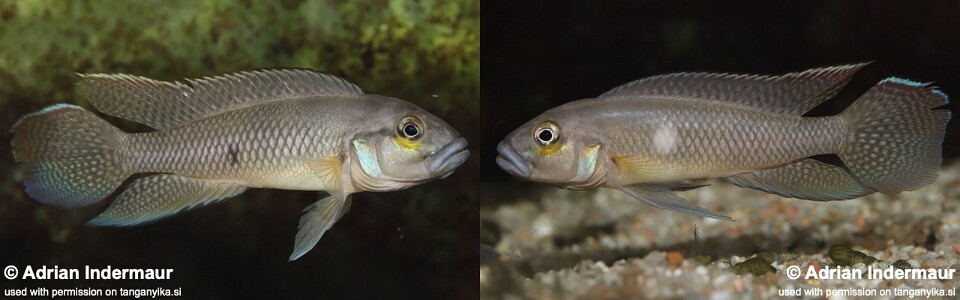



It differs from all congeners by having exclusively unicuspid teeth in the inner rows of the oral jaws and shows strong external resemblance to the Telmatochromis dhonti species group.
The species appears to be riverine in origin but is also present seasonally in the Malagarasi delta, suggesting possible seasonal migration.
Photo gallery