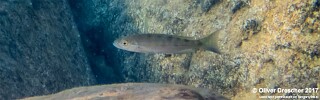
Occurs in a wide range of habitats, but is most frequently encountered in
the rocky habitat, generally in water shallower than about 40 meters.
Geographic distribution:
Endemic to Lake Tanganyika with a lake-wide distribution. It is found in
virtually all habitat types and is especially common in rocky areas.
Typical adult size:
Males can reach about 12 cm total length; females are slightly smaller,
around 11 cm.
Sexual dimorphism:
No clear external differences are described. During the breeding period,
the slightly larger male may show more blue highlights on the flank than
the female.
Recommended aquarium size:
At least 250 liters and longer than 100 cm, especially when starting with
a small group of juveniles to allow a pair to form.
Aquarium setup:
Best maintained as a single pair in a dedicated aquarium, as it will still
attack other fish even when accepting prepared foods.
A practical approach is to raise a small juvenile group together and
remove surplus individuals once a stable pair forms.
Provide rock structures and territories; robust rock-dwelling cichlids are
sometimes attacked less frequently than newly introduced fish, but
co-housing remains risky. It has been noted that Altolamprologus spp.
are generally not targeted as often.
Diet:
A highly specialized scale-eater. In the lake it most often targets
deep-bodied cichlids of similar or larger size, frequently including
Tropheus and Petrochromis.
Attacks are fast “hit-and-run” strikes that can dislodge many scales in
under a second; the nutritional value of scales and mucus is considered
sufficient to form the main component of a healthy diet, and prey rapidly
regenerate lost scales.
Breeding:
Breeding involves a pair bond. Although the female mouthbroods the eggs,
spawning occurs on the substrate and eggs may be taken into the mouth soon
after fertilization or, in some observations, after a longer delay.
Spawns typically exceed 200 small eggs. Eggs hatch after about two days,
and fry are released roughly a week later; brood care continues well
beyond first release.
Both parents defend and retrieve free-swimming fry for at least several
weeks; fry-guarding and retrieving by the male have been documented, and
fry may be moved or “placed” among other guarded schools in certain
circumstances.
Young feed on plankton initially and shift toward scale-feeding as they
grow (around 4–5 cm).
Aggression:
Notable aggression and predatory harassment toward other fishes is typical,
consistent with its scale-feeding strategy. Individuals may also strike
conspecifics, and newly introduced fishes are often targeted more than
long-established tankmates.
Special notes:
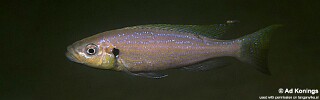
All Tanganyikan scale-eaters have a single row of
enlarged oral teeth; in this species the teeth are comparatively small,
broad-based, and short-crowned, with the upper corners forming a pair of
spine-like points. It is most similar to Perissodus eccentricus, but
has a smaller eye, a shallower body, more dorsal-fin spines, and heavier
pigmentation of the head and fins.



A practical approach is to raise a small juvenile group together and remove surplus individuals once a stable pair forms.
Provide rock structures and territories; robust rock-dwelling cichlids are sometimes attacked less frequently than newly introduced fish, but co-housing remains risky. It has been noted that Altolamprologus spp. are generally not targeted as often.
Attacks are fast “hit-and-run” strikes that can dislodge many scales in under a second; the nutritional value of scales and mucus is considered sufficient to form the main component of a healthy diet, and prey rapidly regenerate lost scales.
Spawns typically exceed 200 small eggs. Eggs hatch after about two days, and fry are released roughly a week later; brood care continues well beyond first release.
Both parents defend and retrieve free-swimming fry for at least several weeks; fry-guarding and retrieving by the male have been documented, and fry may be moved or “placed” among other guarded schools in certain circumstances.
Young feed on plankton initially and shift toward scale-feeding as they grow (around 4–5 cm).
Photo gallery