Ubwari Peninsula, Lake Tanganyika, Democratic Republic of Congo
Biotope:
Deep rocky habitat. The species lives close to the rocky substrate, with territorial
males usually defending areas along vertical rock faces rather than inside caves.
It may occur from shallow water at only a few meters depth down to 30–40 meters.
Non-territorial individuals feed in the open water column but never venture far from
the rocks.
Geographic distribution:
Endemic to Lake Tanganyika and distributed throughout the lake.
Several geographically distinct populations are known.
Typical adult size:
Up to about 10 cm total length.
Sexual dimorphism:
Sexes are similar in overall appearance.
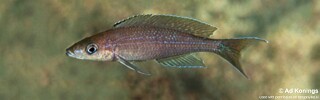
Compared to Paracyprichromis nigripinnis, this species is characterized by
smaller eyes and a more elongated, less deep body shape.
Recommended aquarium size:
Minimum 250 liters.
Aquarium setup:
Should be kept in groups of at least 10 individuals, reflecting its natural
schooling behavior.
Provide ample open swimming space and several large, vertically placed rocks that
serve as shelter and spawning sites.
Lighting should be relatively subdued.
The species must not be kept with aggressive cichlids; suitable tankmates include
peaceful bottom-dwelling species such as Xenotilapia.
Diet:
Carnivorous. Feeds on zooplankton and small crustaceans taken from the open water
column.
Breeding:
Maternal mouthbrooder. Males maintain territories against vertical rock faces.
Spawning takes place head-down against the rock surface.
The female releases one egg at a time; the male immediately releases sperm in front
of the falling egg, fertilizing it before the female collects it in her mouth.
The entire process occurs extremely rapidly.
Eggs are relatively large; clutch size is usually 8–15 eggs, with a maximum of about
25. The female broods for approximately three weeks before releasing the fry, which
immediately join schools of similarly sized juveniles.
Aggression:
Relatively peaceful and should not be kept with aggressive species.
Special notes:
Paracyprichromis brieni is commonly found sympatrically with
Paracyprichromis nigripinnis, but differs by having smaller eyes and a more
slender, elongated body.
Although traditionally treated as one of only two lake-wide species in the genus,
several distinct populations currently assigned to P. brieni show notable
morphological differences. These populations have not yet been taxonomically
investigated in detail, but some may represent separate species.
A notable example is a population discovered in southern Tanzania in 2008, which
combines vertical bars typical of P. brieni with horizontal blue flank
patterning reminiscent of P. nigripinnis. This population is currently
referred to as Paracyprichromis sp. 'brieni two-stripe' and is treated as
distinct from P. brieni.
Both P. brieni and P. nigripinnis were originally placed in the
genus Cyprichromis and were reassigned to Paracyprichromis by Poll
in 1986. Subsequent mtDNA analyses demonstrated that the Paracyprichromis species are closely
related to each other but not to species of Cyprichromis.
A key biological distinction from Cyprichromis is that fertilization in
Paracyprichromis takes place outside the female’s mouth.





Non-territorial individuals feed in the open water column but never venture far from the rocks.
Provide ample open swimming space and several large, vertically placed rocks that serve as shelter and spawning sites. Lighting should be relatively subdued. The species must not be kept with aggressive cichlids; suitable tankmates include peaceful bottom-dwelling species such as Xenotilapia.
The female releases one egg at a time; the male immediately releases sperm in front of the falling egg, fertilizing it before the female collects it in her mouth. The entire process occurs extremely rapidly.
Eggs are relatively large; clutch size is usually 8–15 eggs, with a maximum of about 25. The female broods for approximately three weeks before releasing the fry, which immediately join schools of similarly sized juveniles.
Although traditionally treated as one of only two lake-wide species in the genus, several distinct populations currently assigned to P. brieni show notable morphological differences. These populations have not yet been taxonomically investigated in detail, but some may represent separate species.
A notable example is a population discovered in southern Tanzania in 2008, which combines vertical bars typical of P. brieni with horizontal blue flank patterning reminiscent of P. nigripinnis. This population is currently referred to as Paracyprichromis sp. 'brieni two-stripe' and is treated as distinct from P. brieni.
Both P. brieni and P. nigripinnis were originally placed in the genus Cyprichromis and were reassigned to Paracyprichromis by Poll in 1986. Subsequent mtDNA analyses demonstrated that the Paracyprichromis species are closely related to each other but not to species of Cyprichromis.
A key biological distinction from Cyprichromis is that fertilization in Paracyprichromis takes place outside the female’s mouth.
Photo gallery