Sandy habitats and sheltered shoreline bays with lush vegetation.
Commonly found in large foraging schools that move through different habitat types, but most often in
sediment-rich environments that may also include rocks. For breeding, males require open sand to construct
spawning sites, although breeding males have also been observed taking refuge among rocks when threatened.
Geographic distribution:
Occurs throughout Lake Tanganyika and in river mouths.
Typical adult size:
Up to 38 cm / 35 cm.
The largest recorded size is 43 cm total length for a male and 35 cm for a female; in aquaria males usually
reach about 30 cm while females are rarely larger than 25 cm.
Sexual dimorphism:
During the breeding season, males become sky blue with a broad red margin in the caudal fin, while
females do not show a comparable breeding coloration change. Outside of breeding, males are typically only
slightly larger; fin shape differs, with larger males developing dorsal and anal fin extensions (the dorsal
extension may reach about halfway along the caudal fin, and the anal fin is pointed). Females lack these
extensions and the fins appear more rounded.
Recommended aquarium size:
1000 L.
Aquarium setup:
Use fine sand as the substrate, and plant selected areas with vegetation.
A large aquarium is considered necessary due to adult size. Fine-grained sand is required if breeding is
intended, as males excavate spawning craters. Extensive rockwork is not required unless the tank is large
enough to also house rock-dwelling cichlids, and ample open swimming space should be provided.
Diet:
Herbivorous in the wild, feeding on algae and diatoms covering sand, plants, and rocks; material is
collected by scraping movements and processed with pharyngeal teeth. Stomach analyses reported large quantities
of diatoms (including Pinnularia and Navicula) alongside sand grains.
In the aquarium it accepts most foods, but should also be offered sufficient plant-based foods.
Breeding:
Maternal mouthbrooder.
Males excavate relatively small, shallow craters (about 40–60 cm in diameter) in very shallow water near
vegetation. A territorial male leads a female to the pit; the female releases eggs in large batches and gathers
them, while the male sheds milt over the eggs and may again shed milt in front of the female’s mouth after the
eggs are collected.
Mouthbrooding females gather in large groups and do not eat while holding eggs and young. A brooding period of
about three weeks has been reported, and up to 300 fry have been found in the mouth of females. Aquarium
observations indicate clutches can consist of 500–1000 eggs.
Aggression:
Highly aggressive within the species, and it is not recommended to keep more than one male with a few
females. Toward other species it is not considered very aggressive, but should still only be housed with
sufficiently large tank mates. Sexually active males can be very aggressive toward each other.
Special notes:
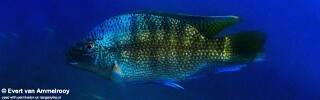
Does not resemble any other Lake Tanganyika cichlid and is readily recognized by its deep body and a
melanin pattern with 5–6 vertical bars below the dorsal fin (not always visible) and two dark longitudinal
bands (one mid-lateral and one dorso-lateral). Juveniles with tricuspid teeth may be confused with
Petrochromis fasciolatus and Interochromis loocki, but those species do not show horizontal
bands on the body and have 7–8 bars below the dorsal fin.
Historically, it was once placed in Petrochromis due to tricuspid teeth and its presence in the same
lake, but it is regarded as a tilapiine and placed with other tilapiines based on genetic data. Molecular work
has been interpreted as indicating that it colonized Lake Tanganyika relatively recently compared with the age
of its broader lineage, and parasite evidence has been described as consistent with affinities to riverine
relatives rather than to other Lake Tanganyika cichlids.




Commonly found in large foraging schools that move through different habitat types, but most often in sediment-rich environments that may also include rocks. For breeding, males require open sand to construct spawning sites, although breeding males have also been observed taking refuge among rocks when threatened.
The largest recorded size is 43 cm total length for a male and 35 cm for a female; in aquaria males usually reach about 30 cm while females are rarely larger than 25 cm.
A large aquarium is considered necessary due to adult size. Fine-grained sand is required if breeding is intended, as males excavate spawning craters. Extensive rockwork is not required unless the tank is large enough to also house rock-dwelling cichlids, and ample open swimming space should be provided.
In the aquarium it accepts most foods, but should also be offered sufficient plant-based foods.
Males excavate relatively small, shallow craters (about 40–60 cm in diameter) in very shallow water near vegetation. A territorial male leads a female to the pit; the female releases eggs in large batches and gathers them, while the male sheds milt over the eggs and may again shed milt in front of the female’s mouth after the eggs are collected.
Mouthbrooding females gather in large groups and do not eat while holding eggs and young. A brooding period of about three weeks has been reported, and up to 300 fry have been found in the mouth of females. Aquarium observations indicate clutches can consist of 500–1000 eggs.
Historically, it was once placed in Petrochromis due to tricuspid teeth and its presence in the same lake, but it is regarded as a tilapiine and placed with other tilapiines based on genetic data. Molecular work has been interpreted as indicating that it colonized Lake Tanganyika relatively recently compared with the age of its broader lineage, and parasite evidence has been described as consistent with affinities to riverine relatives rather than to other Lake Tanganyika cichlids.
Photo gallery