
Lake Tanganyika cichlids — species, locations & maps
Lake Tanganyika cichlids — species, locations & maps
tanganyika.si
Lake Tanganyika cichlids — species, locations & maps.
All images are used with permission of the authors. Unauthorized use is prohibited.


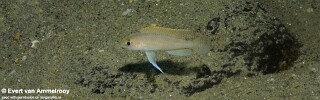




This habitat is formed where a sandy or muddy bottom meets small to large rocks and stones that create caves and crevices.
Maximum size is also reported as about 80 mm for both sexes, with the possibility of somewhat larger individuals in captivity.
Some observations report similar size and coloration in both sexes at certain localities, while at other localities males may be slightly larger and more colorful.
Due to strong intolerance toward conspecifics, keep only as a pair. In a sufficiently large aquarium, it may be kept with other suitably large Lake Tanganyika cichlids, but the pair will defend a territory vigorously.
As a deepwater species, it is best kept under relatively subdued lighting. Hard, alkaline water is recommended, with slightly cooler temperatures reported at 23–25 °C.
No distinct spawning season has been reported. High intolerance toward conspecifics outside reproductive periods has been noted.
A sufficiently large aquarium and well-defined territories are important.
At Kasanga, Tanzania, a similar form was photographed by Ad Konings in 2002 and referred to as Neolamprologus sp. ‘ventralis kasanga’, later exported under the trade name Neolamprologus sp. ‘red dorsal ventralis’. This form inhabits the same depth range and habitat as N. ventralis. Despite having been treated as N. ventralis by Konings, the form known as Neolamprologus sp. ‘ventralis kasanga’ is generally regarded as a separate species based on consistent morphological and behavioural differences. Reported differences include much shorter ventral fins in both sexes, a smaller and less colorful female, a deeper body, shorter snout, reduced dorsal and anal fin height, fewer lateral line scales (31–32 versus 34–36), and a markedly milder temperament in captivity, which has been associated with easier spawning.
Buscher has also mentioned another very similar form from the south-western part of the lake, between the Congo border and Nsumbu National Park, distinguished by the presence of several vertical bars along the body; this form is referred to on tanganyika.si as Neolamprologus sp. ‘ventralis striped’ and is considered likely to represent an as yet undescribed species.
Photo gallery