Kavala Island, Bracone Bay, Lake Tanganyika, Democratic Republic of Congo
Biotope:
Inhabits an intermediate sand–rock habitat, where it is often found together with
N. tretocephalus. Although they share the same environment, dietary competition is limited,
as N. toae feeds mainly on crustaceans, while N. tretocephalus primarily consumes
insect larvae. N. toae is predominantly nocturnal.
Geographic distribution:
Widely distributed across the northern part of Lake Tanganyika. It is absent only along the
coast of Burundi. Toward the south, it occurs as far as Cape Tembwe on the western shore and Cape
Mpimbwe on the eastern shore.
Typical adult size:
Up to about 10 cm in total length; in aquaria it may grow slightly larger.
Sexual dimorphism:
Sexes are very similar in appearance; males are slightly larger than females.
Recommended aquarium size:
200 L for a pair.
Aquarium setup:
A rather rare species in aquaria. Compared to most lamprologines, it is among the calmer
Neolamprologus species and is considerably less aggressive than
N. tretocephalus, with which it shares its natural habitat.
The species is characterised by slow movements. It is best kept as a pair, but it can also be
housed in a Tanganyika community aquarium provided the tank volume is at least 300 L or dimensions
are around 120 × 50 cm.
The substrate should be fine sand, complemented with several rocks to recreate an intermediate
sand–rock environment.
Diet:
Carnivorous. Feeds mainly on crustaceans, but also takes other soft-bodied invertebrates and
mosquito larvae. Feeding activity occurs primarily at night under dim light conditions, aided by
its enlarged eyes and specialised head sensory system.
Breeding:
Breeds in shallow water. Both parents guard the offspring for approximately 12 weeks before
spawning again.
Egg numbers range from about 150 to 250. A notable feature is that eggs are initially laid on open
substrate, which is unusual for smaller lamprologines. Because of this exposed placement, both
parents actively participate in guarding the clutch.
After approximately 4–5 days, the eggs are usually moved into a cave, where they are better
protected.
Aggression:
Relatively peaceful for a lamprologine. Considerably less aggressive than
N. tretocephalus, even though both species share the same habitat.
Special notes:
This species was previously placed in the genus Paleolamprologus. Due to its highly
developed sensory system, Colombe and Allgayer (1985) erected the genus
Paleolamprologus for this species.
It was later reassigned to Neolamprologus in 1997 after Stiassny demonstrated that, aside
from the advanced sensory system, no other characters reliably separate it from other
Neolamprologus species.
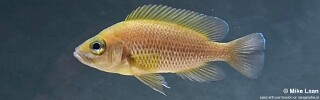
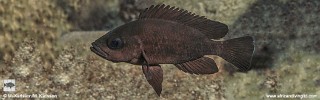
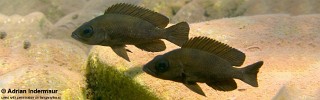
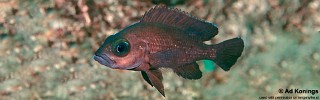
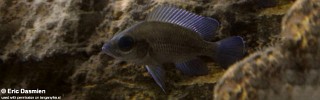
Morphologically, the species is unmistakable by its laterally compressed body, with the deepest
point immediately behind the opercle, short and rounded fins, a large head with enormous eyes, and
enlarged sensory pores. Overall coloration is dark grey with minimal ornamentation, apart from
slight fin edging and more or less silvery body scales.
Across its wide distribution, the species is relatively homogeneous, although there is a gradual
change in the presence of opaline dots on scales and fins: these markings are most pronounced in
northern Congolese populations, become more scattered in northern Tanzanian fish, and may almost
disappear in southern populations.
The open-substrate spawning behaviour is considered a rather primitive trait and is uncommon among
lamprologines, except in large or powerful species capable of effectively defending exposed eggs.
With its distinctive shape, behaviour, and enormous eyes, Neolamprologus toae has no close
living relatives.



The species is characterised by slow movements. It is best kept as a pair, but it can also be housed in a Tanganyika community aquarium provided the tank volume is at least 300 L or dimensions are around 120 × 50 cm.
The substrate should be fine sand, complemented with several rocks to recreate an intermediate sand–rock environment.
Egg numbers range from about 150 to 250. A notable feature is that eggs are initially laid on open substrate, which is unusual for smaller lamprologines. Because of this exposed placement, both parents actively participate in guarding the clutch.
After approximately 4–5 days, the eggs are usually moved into a cave, where they are better protected.
It was later reassigned to Neolamprologus in 1997 after Stiassny demonstrated that, aside from the advanced sensory system, no other characters reliably separate it from other Neolamprologus species.
Morphologically, the species is unmistakable by its laterally compressed body, with the deepest point immediately behind the opercle, short and rounded fins, a large head with enormous eyes, and enlarged sensory pores. Overall coloration is dark grey with minimal ornamentation, apart from slight fin edging and more or less silvery body scales.
Across its wide distribution, the species is relatively homogeneous, although there is a gradual change in the presence of opaline dots on scales and fins: these markings are most pronounced in northern Congolese populations, become more scattered in northern Tanzanian fish, and may almost disappear in southern populations.
The open-substrate spawning behaviour is considered a rather primitive trait and is uncommon among lamprologines, except in large or powerful species capable of effectively defending exposed eggs. With its distinctive shape, behaviour, and enormous eyes, Neolamprologus toae has no close living relatives.
Photo gallery